A wedding venue in France with accommodation means guests sleep on the property itself, not in a hotel down the road, with no taxi and no drive back at the end of the night. That sounds like a simple distinction. It isn’t. Most venues that advertise “on-site accommodation” only have enough bedrooms for a fraction of the people who’ll actually be there, and the gap between what the brochure implies and what happens on the night rarely gets explained until the couple is already deep into planning.
That gap is worth understanding before you fall in love with a courtyard photo.
How Many Guests Can Actually Sleep at a French Wedding Venue?
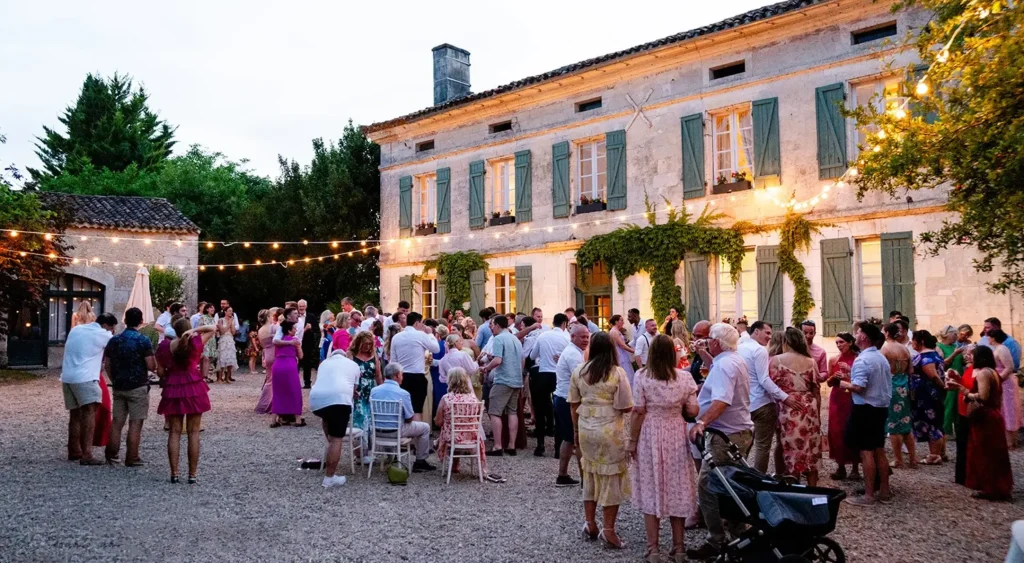
Most French wedding venue listings quote two numbers, and they don’t mean the same thing. One is reception capacity: how many people can fit in the barn, the marquee, or the dining hall for the meal and the dancing. The other is sleeping capacity: how many of those people can actually stay the night. Across the French wedding venue market, that sleeping number typically sits somewhere between 20 and 40 guests, regardless of how large the reception capacity looks on the listing.
A château that caters for 150 guests might sleep 30. A domaine advertised for 200 might have accommodation for 40, with the rest expected to book rooms in the nearest town. The mismatch comes from the buildings themselves. Most châteaux were built as private residences with a handful of bedrooms, not as hotels, long before anyone was renting them out for weddings. In practice, “accommodation” on most listings means the wedding party and immediate family, with everyone else needing a car and a booking reference for somewhere twenty minutes away.
Why On-Site Accommodation Changes the Wedding Weekend
A wedding isn’t one event. It’s a sequence: the ceremony, the meal, the dancing, and then whatever happens after midnight when the music stops but nobody wants to go home yet. When guests are staying off-site, that last part gets cut short by necessity. The band gets told to wrap up early. Someone starts a round of goodbyes that turns into twenty separate goodbyes, each one a small deflation of the night.
On-site accommodation changes that shape entirely. Instead of a wedding day, you get a wedding weekend. Breakfast the next morning happens together, in pyjamas, with the same people who were dancing at 2am. Nobody is doing the sums on how many drinks it’s safe to have before the drive back. The whole thing stretches out and softens, and that’s a different experience from a single, tightly scheduled event with a hard stop.
There’s also a practical layer underneath the emotional one. Off-site accommodation means coordinating transport and briefing guests on directions in a language many of them don’t speak. It also means hoping nobody’s satnav sends them down the wrong farm track at midnight. For a destination wedding, where most guests have already flown or driven a long way to be there, all of that lands on the couple, and it lands in the two weeks before the wedding that are supposed to feel like anticipation, not a second job in guest logistics.
Questions to Ask Before Booking a Wedding Venue in France
Before booking any venue that claims to offer accommodation, there are a few direct questions worth putting to the venue rather than assuming the answer.
How many bedrooms are actually on the property, and how many people do they sleep? Ask for the real bed count, not the reception capacity dressed up as one.
Find out whether the accommodation is included in the venue hire, or whether it’s a separate booking with its own contract, deposit, and cancellation terms. A venue that bundles accommodation into the hire price often looks more expensive on paper than one quoting a lower headline fee, but that headline fee rarely includes the two or three nights of hotel rooms your guests would otherwise be booking anyway, so the real comparison is total cost, not the number quoted first.
Where does the ceremony itself take place? Some venues sell accommodation and reception space but expect the ceremony to happen at a nearby town hall or church, which adds another logistical layer and another journey for guests who’ve already travelled a long way.
Ask what happens to the guests who don’t fit in the on-site rooms. A good venue will already have an answer, whether that’s a partnered gîte (a self-catering holiday property, typically rural) down the road or a clear plan for overflow. A vague answer here is a sign the accommodation offer is thinner than it looks.
Is the property exclusive-use for the whole weekend, or shared with other guests or the owner’s family? Exclusivity changes how relaxed the atmosphere feels, particularly late at night.
What Genuine On-Site Accommodation Looks Like at Scale
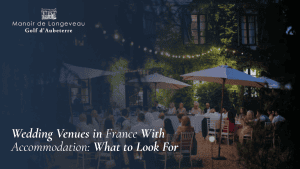
Manoir de Longeveau, a private estate on the Charente and Dordogne border in southwest France, is a useful example of what this looks like when a venue is actually built for it rather than adapting a family home to the purpose. The estate sleeps over 190 guests across 36 individual properties, with the bridal suite inside the 17th-century Manoir itself. For the duration of the wedding, the entire estate operates as a private village. Every guest, not just the wedding party, stays on the grounds. Nobody disperses to a hotel when the night winds down, because there’s nowhere else anyone needs to be.
A wedding at Longeveau also includes the ceremony on-site, which removes the town hall detour that most destination weddings in France still require. Guests arrive once and stay put until it’s time to go home.
That scale is unusual. Most French wedding venues, including many beautiful ones, were never designed to house an entire guest list, and there’s nothing wrong with a smaller property if the couple plans around it properly. It’s worth understanding how a private estate compares to a traditional château venue before deciding which model actually suits your guest list. What makes Longeveau worth noting is that its sleeping capacity and its guest capacity are, for practical purposes, the same number, which is rare enough to be the exception rather than the standard.
Why Location Doesn’t Guarantee On-Site Accommodation
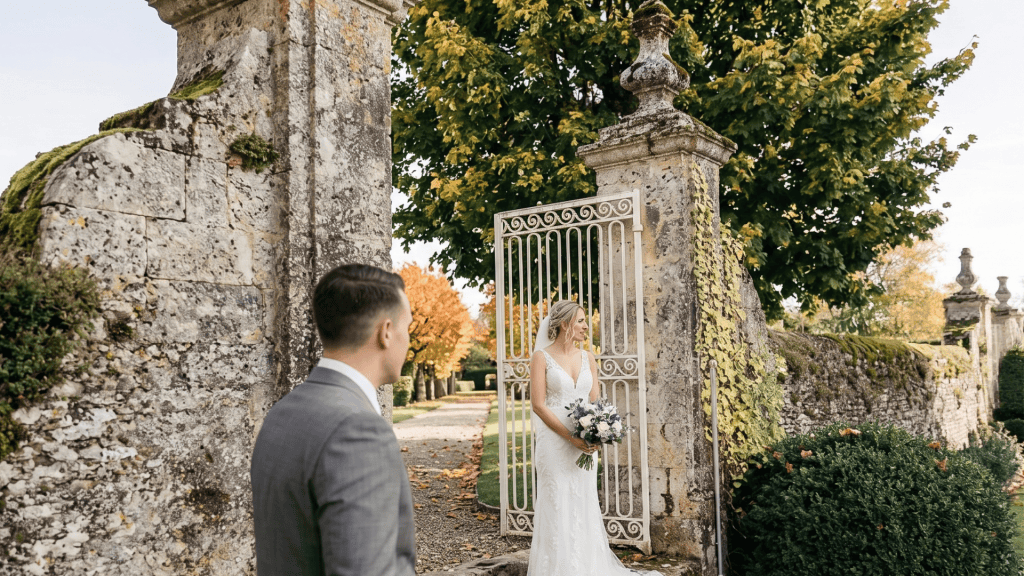
Southwest France, the Dordogne, and the vineyard country around Bordeaux all carry the same romantic weight in wedding photography: stone courtyards, long dinner tables under trees, vineyard rows running to the horizon. That scenery sells the dream, and it’s a real part of why couples choose a French wedding over one closer to home.
But the region doesn’t answer the accommodation question. A château nestled in the heart of Bordeaux wine country can have exactly the same sleeping shortfall as one two hours away. The address tells you what the wedding will look like in photographs. It tells you nothing about where two-thirds of your guests will be sleeping.
This is worth separating clearly when comparing venues, because the two decisions get conflated constantly. Choose the region for the atmosphere you want. Then evaluate the venue’s actual accommodation model on its own terms, regardless of how good the setting looks in the drone shot.
How to Compare Wedding Venues With Accommodation
If you’re currently working through a shortlist, the priority is simple: put sleeping capacity ahead of every other number a venue gives you, confirm whether it’s included in the hire or booked separately, and get a straight answer on where the overflow goes before you get attached to anything else about the property.
A wedding venue in France earns the description “genuine on-site accommodation” because the numbers add up for your actual guest count, not because of how it photographs. The answer to “where does everyone sleep” shouldn’t need three follow-up emails to clarify. Once you know what you’re actually looking for, the venues that were quietly overselling their accommodation tend to reveal themselves quickly, and the ones built properly for it stand out just as fast.