One of the things that surprises families staying in this part of south-west France is how much is within reach without a long drive. The Charente-Dordogne border sits at a geographical sweet spot: the northern Dordogne is immediately to the east, the Charente stretches north and west, and the combination gives you access to a genuinely varied set of day trips within forty-five minutes to an hour in any direction.
The challenge is not finding things to do. It is choosing between them and sequencing the week so that the days feel varied rather than samey. This guide covers the options that work best for families, in honest detail, so that you can make the decision that suits your particular group rather than defaulting to the nearest thing on the map.
All distances are from Longeveau. If you are staying at Longeveau and want a local steer on any of these, the team is always happy to help you plan. But most of what follows is self-explanatory once you know what is there.
Aubeterre-sur-Dronne
5 minutes by car · 10 minutes by taxi
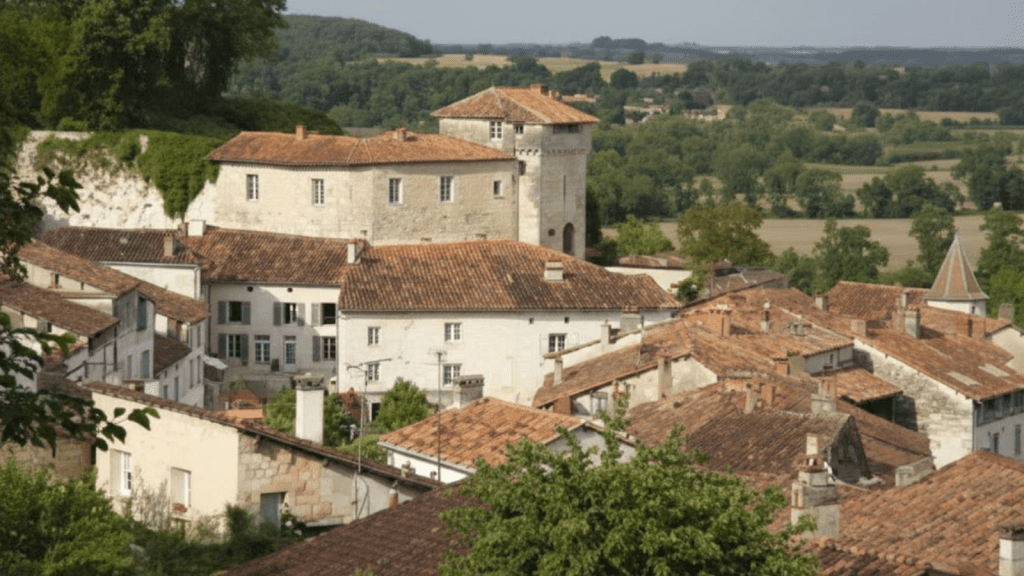
The closest option is not a day trip in the conventional sense, but it earns its place at the top of this list because most families end up visiting Aubeterre multiple times across a week rather than once. It is that kind of place.
The village is officially one of the les Plus Beaux Villages de France{target=”_blank”}, the national register of France’s most beautiful villages, and the title is deserved. The square at the top of the village is the natural gathering point, with café terraces facing the afternoon sun and a Sunday morning market that draws local producers and artists from across the area. The underground church carved from the cliff face below the square is extraordinary for all ages, a twenty-metre cave-church that took Benedictine monks several centuries to excavate and that children almost universally find more impressive than any surface-level heritage site they have visited.
At the bottom of the hill, the river beach on the Dronne is the easiest swimming option in the area, with a playground, a volleyball court and supervised bathing in summer. Canoeing on the Dronne from the hire base at the foot of the village adds a different dimension on a second visit, with routes from ninety minutes upward that suit all ages from about six or seven onwards.
The practical advice for Aubeterre is to separate the village from the river beach rather than trying to do both in a single push. The hill between them is steep enough to make carrying small children and beach bags uncomfortable. A morning in the village and an afternoon on the beach, with a long lunch in between, is the natural rhythm.
Ribérac and the Friday Market
30 minutes by car · 35 minutes by taxi
Ribérac earns its place on this list almost entirely on the strength of one morning per week. The Ribérac Friday market is the largest in the Périgord and runs from eight in the morning until one, filling the town centre across multiple streets with a mix of local food producers, general market stalls, clothing, plants and seasonal goods. It is not a polished artisan market. It is a proper French working market that happens to be excellent, and the difference matters.
For families, it works because there is something for everyone at a market of this scale. Small children are absorbed by the noise and movement. Grandparents are in their element. Teenagers who are allowed to wander independently tend to find their own reasons to be interested. The rotisserie chicken stalls and the paella pans are reliable crowd-pleasers across all ages, and a picnic assembled from the market and eaten somewhere along the Dronne on the way back is one of those simple holiday experiences that tends to be remembered long after the organised activities have faded.
Arrive before nine in the morning for parking. The market winds down noticeably after eleven-thirty. Combining the Friday market with a stop at Aubeterre-sur-Dronne{target=”_blank”} on the way back makes a natural half-day that works for all ages without requiring anyone to stay out past nap time.
The Grand Étang de la Jemaye
40 minutes by car · 45 minutes by taxi
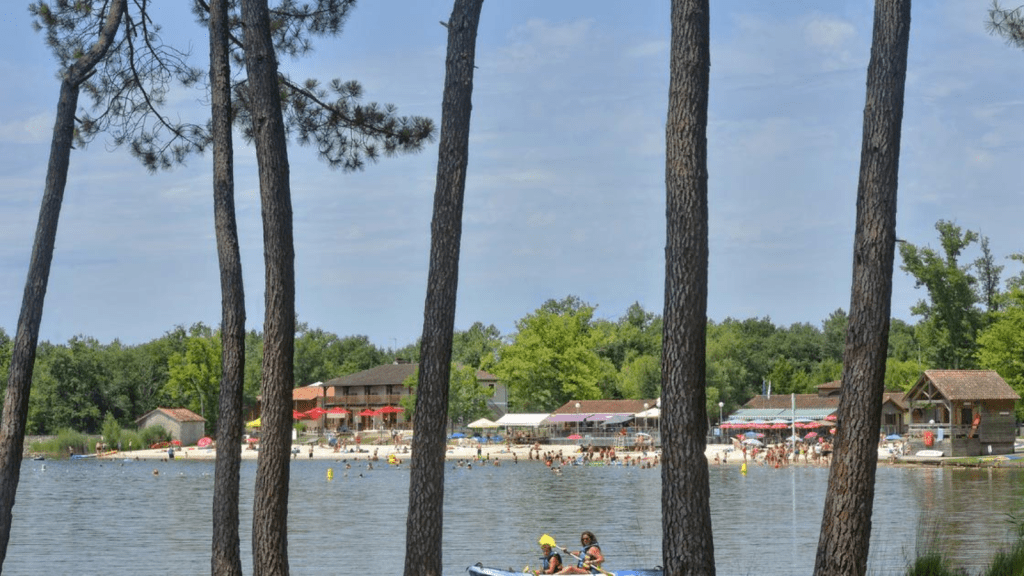
The lake at La Jemaye, in the Double Forest of the northern Dordogne, is the single best full-day option for families with children of any age. Entry is free. Parking is free. The sandy beach is genuine, with soft ground leading gently into warm freshwater that is supervised by lifeguards from mid-June to the end of August. The depth increases gradually enough that toddlers can paddle safely at the edge while older children swim properly in the marked area.
Free canoes and paddleboards are available from the beach in summer, which is the kind of unexpected addition that makes a lake day feel substantially better than it would otherwise. A playground sits immediately adjacent to the beach so that children who are done with the water have somewhere to go without leaving the site. Two snack bars and a restaurant provide food, and there is enough shade from the surrounding pine forest to make a full August day manageable without everyone retreating inside at noon.
The lake also sits within the larger Double Forest, a protected natural area of nearly fifty thousand hectares, and a walking trail circles the full circumference of the lake through the trees. The trail is suitable for pushchairs on the main path and takes around an hour at a gentle pace. For families who want more than a beach day without driving somewhere else entirely, the combination of the lake and the forest walk fills the hours comfortably.
There is no entry fee and no booking required. The practical advice is to arrive before ten in the morning in peak summer weeks, as the beach fills through the morning and parking becomes more complicated after that.
The Grotte de Villars
50 minutes by car · 55 minutes by taxi
The Grotte de Villars is the most consistently impressive day out in the wider area for families with children over about five, and one of the most genuinely memorable experiences available anywhere in the northern Dordogne.
It is the only cave in the Périgord that contains both original prehistoric paintings and the full range of natural calcite formations in the same underground space. The guided tour covers six hundred metres over approximately an hour, with English-speaking guides and a format that holds children’s attention considerably better than most heritage site visits. The prehistoric paintings are approximately nineteen to twenty thousand years old and are covered in a thin layer of calcite that has turned several of them an unlikely shade of blue. The little blue horse and the bison-and-human scene are the two images that tend to stay with children longest.
The cave sits at a constant thirteen degrees throughout the year, which makes it as welcome on a thirty-five-degree August afternoon as on a cool September morning. Bring a layer for everyone regardless of the outside temperature.
After the cave, the outdoor Cro-Magnon garden extends the visit with educational displays and, on weekday afternoons in July and August, free activity workshops including cave painting and reconstructed Palaeolithic spear-throwing. These are better than they sound and are worth staying for if your schedule allows.
Adult admission is €12, children five to eleven €7.50. Booking online in advance is strongly recommended in July and August as tours fill quickly. The cave combines naturally with Brantôme, fifteen minutes further along the road, making it the obvious pairing for a full day in the northern Dordogne.
Brantôme
50 minutes by car · 55 minutes by taxi
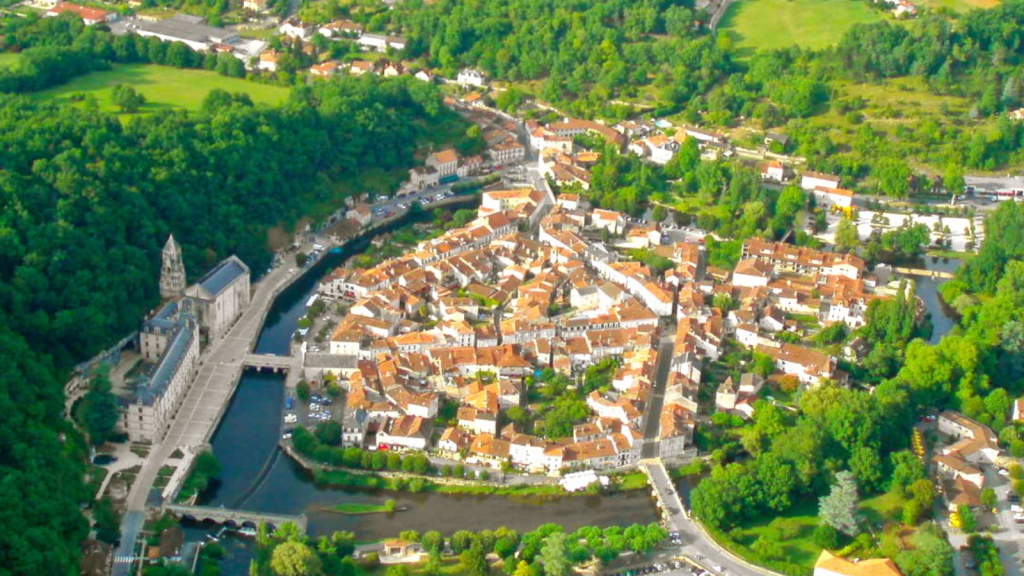
Known as the Venice of the Périgord, Brantôme is built on an island in the River Dronne with water on every side and a Benedictine abbey backing directly against the cliff face behind it. The physical setting is striking in a way that requires no particular interest in medieval history to appreciate, and children respond to the combination of water, bridges, weirs and island geography in a way that they do not always respond to pretty French towns.
The abbey caves, accessible as part of a guided tour, are a good complement to the Grotte de Villars on the same day: different in character and geological interest, but atmospheric and historically distinctive. The river walk around the island is short and flat, suitable for all ages, and the crêperies and cafés along the waterfront are reliably good. A morning at the Grotte de Villars and an afternoon in Brantôme, with lunch somewhere between the two, is the combination that most families find works best as a single day out.
Brantôme{target=”_blank”} also holds a Friday morning market, smaller than Ribérac but pleasant to walk around with children. If you are combining the cave and the town on a Friday, arriving at the market before heading to the cave in the late morning avoids the midday crowds at both.
Périgueux
45 minutes by car · 50 minutes by taxi
Périgueux, the capital of the Dordogne, earns its place on the family day trip list primarily because of two things that are better for children than most Dordogne towns manage: the Vesunna Gallo-Roman Museum and the Wednesday and Saturday morning market.
The Vesunna Museum, designed by the Pritzker Prize-winning architect Jean Nouvel and built over a Roman house discovered in 1959, has a quality of experience that few regional museums achieve. The building is extraordinary in itself, a glass and steel structure that encloses the ruins without separating them from the visitor. The painted plaster walls of the original Roman house are visible from the walkways above. Children who have arrived expecting a museum and found themselves standing above the actual floor of a house that was abandoned nearly two thousand years ago tend to respond differently from how they respond to objects in cases. There is an English-language audio guide and the visit takes around an hour at a comfortable pace.
The medieval quarter around the Cathédrale Saint-Front is walkable and varied, with streets narrow enough to feel genuinely old and the Byzantine domes of the cathedral visible above the rooftops from several directions. The cathedral’s interior has an unusual quality of light that is worth ten minutes even for families who are not particularly interested in churches.
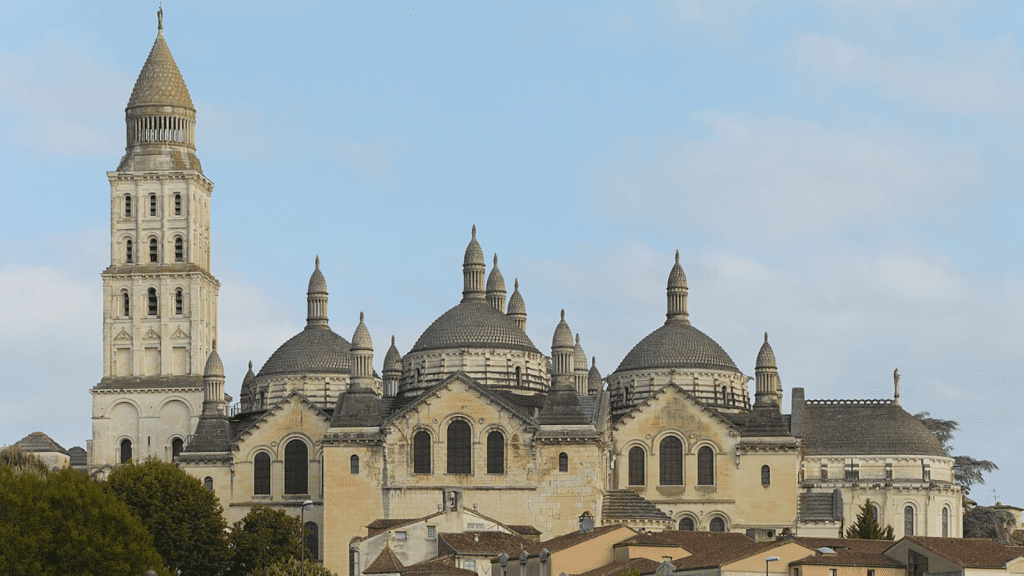
Périgueux works best as a day when the market is running. Wednesday and Saturday mornings at Place du Coderc and Place de la Clautre fill with local producers and, from November to February, a truffle and foie gras section that is worth seeing even if you are not buying. Park at Place Francheville on the edge of the old town and the rest is walkable.
Planning the Week
The sequencing that tends to work best for a week at Longeveau is to keep the first day or two close to home, using the estate, Aubeterre and the river beach as the foundation while the group settles in. From day three onward, one day trip every two days gives the week variety without making every morning a car journey. The lake at La Jemaye is the natural first full day out. The Grotte de Villars and Brantôme paired together fill a second. A Friday morning at the Ribérac market, followed by a slow drive home via Aubeterre, rounds out the week.
For families staying longer than a week, Périgueux is a day for the middle of the second week when everyone is comfortable with the area and ready for something more urban. For any questions about how to fit the options together, the team at Longeveau knows the area well and is happy to help. Just get in touch.
Manoir de Longeveau — 35 self-catering gîtes with heated pools, on-site golf and tennis, minutes from Aubeterre-sur-Dronne.
Browse the gîtes