The multi-generational holiday is one of the more optimistic things a family can attempt. The vision is lovely: grandparents, parents, teenagers and small children all together in a beautiful place, sharing meals and making memories across the generations. The reality, if you have not thought it through carefully, can involve a toddler having a meltdown in a cave while a teenager sulks on a terrace and a grandparent politely wonders why anyone thought this was a good idea.
Getting it right is entirely possible. But it requires accepting one thing at the outset: a mixed-age holiday is not a holiday you can plan around a single activity or a single rhythm. It is a holiday you plan around a place, and then let the different ages find what they need within it.
Why Destination Matters More Than Itinerary

The instinct when planning a group holiday with a wide age range is to build an itinerary that includes something for everyone. This sounds sensible and almost always produces a week of compromises where nobody gets quite what they wanted and everyone feels mildly responsible for the others not enjoying themselves.
A better approach is to choose a destination that has enough variety and enough physical space that different ages can genuinely follow their own version of the holiday while still overlapping at the parts that matter. The shared meals, the evening on the terrace, the one day out that everyone agrees to: these are the memories that tend to endure. The other days, the ones where the teenagers went to the river and the grandparents sat in the garden and the small children napped for two hours in the afternoon, are the days that actually make the shared moments possible by not forcing everyone into the same experience simultaneously.
This is why the rural south-west France model works particularly well for mixed-age groups. An estate like Longeveau, with self-catering cottages across a shared property, gives everyone their own space while keeping the group within reach. Nobody is stuck together in adjacent hotel rooms. Nobody has to negotiate a shared restaurant every night. The grandparents can have a quiet morning with coffee and a book. The small children can have a nap. The teenagers can disappear to the pool. And the family can reconvene for dinner on the terrace without anyone having had to manage anyone else’s afternoon.
Planning for Grandparents
Grandparents on a mixed-age family holiday tend to have two things they want that are easy to underestimate: time with the grandchildren on their own terms, and time that is theirs without obligation.
The first is straightforward to create in a rural France context. The village market, a gentle walk to a viewpoint, a quiet hour in a café square while the small children eat an ice cream: these are the experiences that grandparents tend to remember, and they require almost nothing in terms of planning or energy. Aubeterre-sur-Dronne, five minutes from Longeveau, is exactly the right kind of place. The square is flat and accessible. The underground church is extraordinary and requires only a gentle descent on a well-maintained path. The café terraces face the afternoon sun. An hour there with a grandchild who is old enough to walk and talk is a genuinely good experience for both parties.
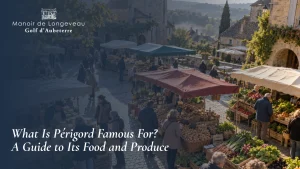
The Ribérac Friday market is also worth noting here. A morning at a proper French market, with a grandparent who remembers how these things work and a child who has never seen one, is a reliable multi-generational experience that costs almost nothing and tends to produce better conversation than most organised activities.
What grandparents typically do not want, though they are unlikely to say so, is to be managed around the preferences of the youngest children in the group for an entire week. Building in time where the adults with pushchairs and nap schedules go one way and the grandparents go another is not a failure of togetherness. It is how a multi-generational holiday actually functions well.
Mobility is worth thinking about honestly. Much of the Dordogne-Charente area is accessible and easy on flat ground, but the village of Aubeterre itself sits on a hill that is steep in places. The underground church, the market square and the riverside area at the bottom of the hill are all accessible without difficulty. The upper streets of the village are not. This is not a reason to avoid Aubeterre but it is worth knowing before you arrive with a grandparent who finds uneven ground difficult.
Planning for Teenagers

Teenagers on family holidays are a category that tends to be either over-managed or entirely neglected, and neither approach produces a good outcome. The over-managed teenager becomes resentful of being treated as a younger child. The entirely neglected teenager checks out and spends the week on their phone, which irritates everyone and produces no memories worth having.
The approach that tends to work is giving teenagers genuine autonomy over a portion of each day while including them in the activities where they actually have something to offer the group. A teenager who is a decent swimmer is an asset at the river beach rather than a liability. A teenager who is physically capable and reasonably adventurous will enjoy canoeing on the Dronne and will enjoy it more if they are not being managed through it by an anxious parent.
The Grotte de Villars is one of those activities that lands well with teenagers despite initial resistance, for the same reason it works with younger children: it is genuinely strange and impressive in a way that does not require any prior interest in geology or prehistory to appreciate. The prehistoric paintings are around nineteen to twenty thousand years old. The cave temperature is thirteen degrees regardless of the season. The little blue horse, covered in a thin film of calcite that has turned it an unexpected colour over millennia, produces a response from most teenagers that is different from the glazed politeness they deploy at churches and museums.
Teenagers also, quietly, tend to appreciate being trusted with small children. A teenager who has been given some responsibility for a younger cousin or sibling for an afternoon, and who has discharged it competently, tends to hold themselves slightly differently for the rest of the day. This is not something to engineer too obviously, but it is something to notice and create space for.
Planning for Small Children
Small children set the floor of the day’s energy expenditure, which is the polite way of saying they dictate the pace for everyone. A morning that begins with a toddler who did not sleep well runs differently from a morning that begins with a toddler who did, and no amount of planning changes this.
The practical response is to build the week around activities that work with a degree of unpredictability rather than against it. The river beach at the foot of Aubeterre is the single most forgiving option in the area: you can arrive at nine in the morning or eleven, stay for two hours or five, leave when the toddler is done rather than when the activity is over. The lake at La Jemaye operates on the same principle, with the added advantage of a playground adjacent to the beach so that small children who are done with swimming have somewhere to go immediately.
Activities with fixed departure times and long guided tours are harder to fit around small children. The Grotte de Villars is excellent for children over five but genuinely difficult with a two-year-old who cannot be expected to stay quiet for an hour underground. This is not a reason to skip it, but it is a reason to split the group: one adult takes the older children and teenagers to the cave while another stays at the outdoor garden with the younger ones, and the roles reverse if there is a second visit.
The Shared Moments That Actually Work
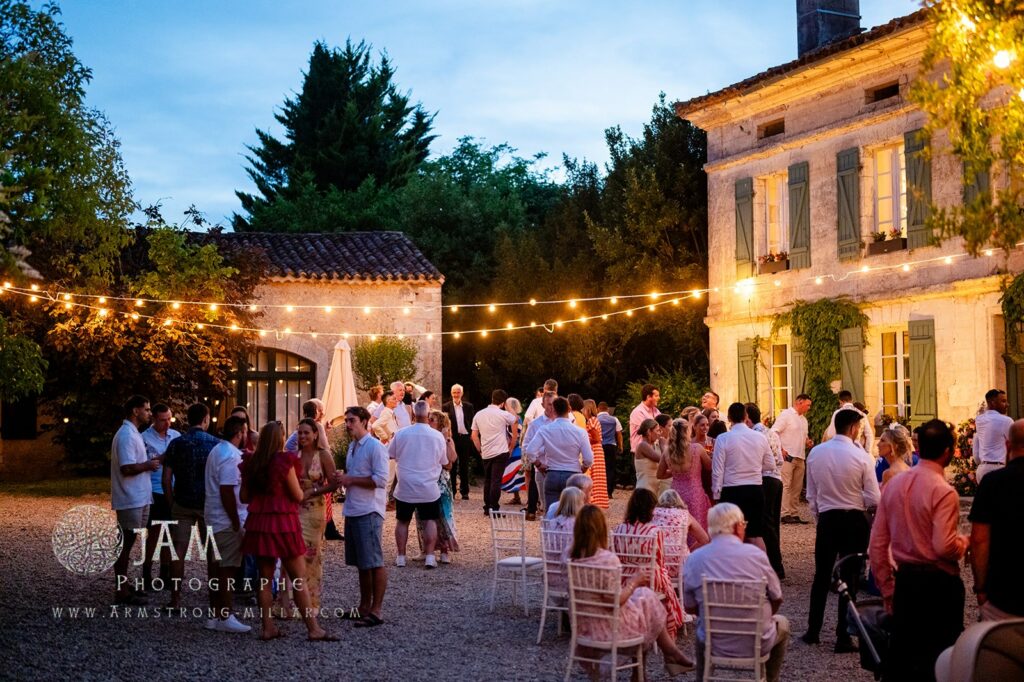
The experiences that tend to bring a mixed-age group together most naturally are the ones where there is no performance required, where everyone is doing the same thing at the same pace and nobody needs to pretend to be enjoying something more than they are.
Evening meals around a large table are the obvious example, and in rural south-west France the conditions for them are good. The light in the Dordogne-Charente in summer lasts until nine-thirty or ten. A table outside a stone cottage in that light, with good wine from the local market, bread from the boulangerie and whatever the group has put together from the day’s shopping, is one of the more reliably enjoyable experiences a mixed-age family can have. It does not require everyone to have had the same day. It requires only that everyone arrives at the table hungry and in reasonable spirits, which the area tends to produce.
Sunday mornings at the Aubeterre market, where the square fills with local producers and artists and the café terraces get genuinely busy, are another. The market is small enough that you can walk around it with a pushchair and a grandparent at the same pace, large enough that there is something to look at, and timed so that a coffee and a croissant in the square is the natural punctuation. It is the kind of experience that requires almost nothing from anyone and tends to be a highlight of the week in retrospect.
The Practical Case for a Private Estate
One of the structural reasons multi-generational holidays go wrong is accommodation that forces the group into too much shared space or too little of it. A hotel requires everyone to be in public together. A single large house can breed the kind of proximity that makes people irritable by Wednesday.
The cottage model at an estate like Longeveau solves this in a way that is difficult to replicate elsewhere. Different family units have their own front door, their own kitchen, their own evening wind-down. The shared grounds, the pool and the communal areas exist for the moments the group chooses to be together rather than as a default. Grandparents can go to bed when they want to. Teenagers can stay up when they want to. Small children can have their routine without disrupting anyone else.
For things to do with kids in the area and a fuller picture of what is within reach during a stay, that guide covers the main options in more detail. If you want to talk through whether Longeveau works for your specific group, the team is genuinely happy to help you think through the logistics. Just get in touch with what you have in mind.
Manoir de Longeveau — 35 self-catering gîtes with heated pools, on-site golf and tennis, minutes from Aubeterre-sur-Dronne.
Browse the gîtes