Dordogne food specialities come down to three things: duck, walnuts, and a black truffle that locals still call a diamond. Every generic guide leads with the same handful of ingredients, but the dishes that actually define this corner of southwest France rarely make it onto that checklist. Order the obvious thing in Périgord and you will eat well. Order the right thing and you will understand why French chefs still talk about this stretch of the Dordogne Valley the way wine people talk about Burgundy.
What Makes Dordogne Food Famous
Ask any first-time visitor what surprised them most about Dordogne food and the answer is usually duck fat. It turns up in the potatoes, the confit, the pâté and even the bread some households fry for breakfast, and once you notice it, you realise it is holding most of the region’s best-known dishes together. Add walnuts pressed into oil, the black truffle hunted through winter oak groves, and a landscape of limestone causses and river valleys that has fed the same families for centuries, and you have food that tastes like the ground it grew from rather than a menu someone designed. People here were eating this way long before tourism ever arrived.
What Is the Difference Between Dordogne and Périgord?
The overlap trips up more visitors than you would think. Dordogne is the modern administrative name for the département, while Périgord is the older, historic name for the same region, split informally into Périgord Noir around Sarlat, Périgord Blanc around Périgueux, and a couple of smaller pockets further out. Menus, market stalls and cheese labels use both names almost interchangeably, so a dish billed as “Périgourdine” and one billed as “de Dordogne” are describing the same kitchen, just with a different accent. The name on the sign tells you which century the business wants to sound like it belongs to. The food underneath is identical.
Where Can You Find the Best Dordogne Specialities?
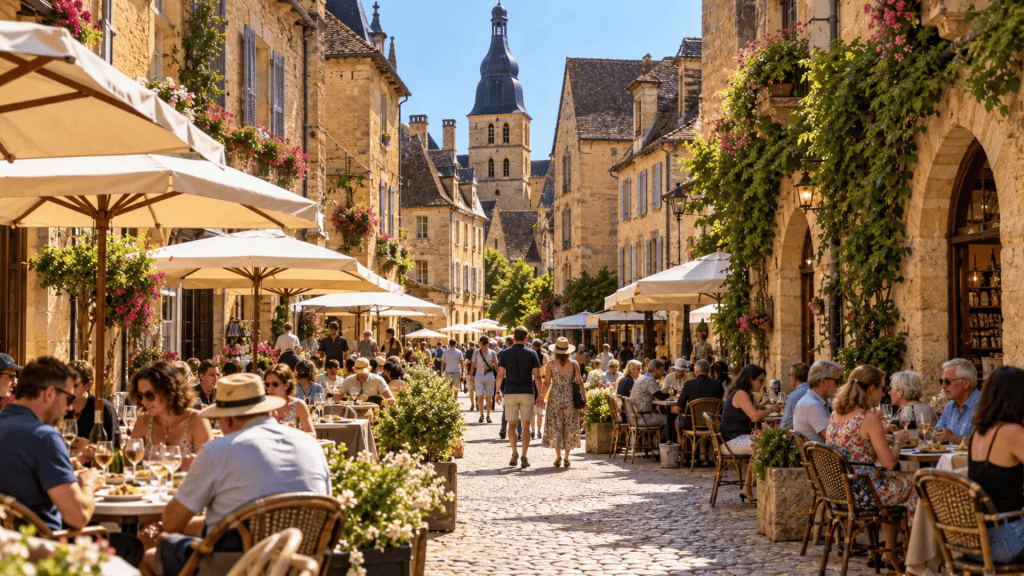
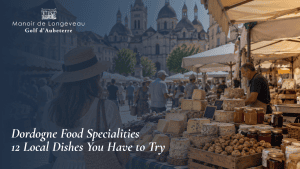
Most of Dordogne’s best food never touches a restaurant menu first. It is already for sale on a market stall, at a farm gate, or straight from the producer who made it. Sarlat’s Saturday market and Périgueux’s Wednesday and Saturday markets sell direct from the producer, not through a menu that has already interpreted the produce for you, and Ribérac’s Friday market works the same way and is worth the detour. The region’s small goat’s cheeses are easiest to buy fresh directly from the fromageries and goat farms that make them rather than a supermarket shelf. Foie gras farms and truffle growers both open their doors to visitors during their respective seasons, winter for truffle hunts led by trained dogs, and much of the year for a walk through the barns where the ducks and geese are raised. None of it requires booking months in advance. Most of it just requires being in the right village on the right morning.
Knowing where to look only gets you halfway there. Knowing exactly what you are looking for is the other half, and that starts with the specialities themselves.
1. Foie Gras, a Luxury French Delicacy
Start here, because everything else on this list exists partly to accompany it. Foie gras is fattened duck or goose liver, and in the Dordogne it is treated less like a delicacy and more like a birthright. That is not just a turn of phrase. Some 10.6 million French households bought foie gras in 2024, and the country now supplies 87% of its own production after several years spent rebuilding flocks lost to bird flu. You will find it pan-seared with figs, set into a smooth terrine, or tinned for the drive home. The best versions come from small producers who open their farms to visitors during the winter, when the foie gras fairs bring in buyers from across France. Order it “mi-cuit” if you want the silkiest texture, and pair it with a glass of Monbazillac, the sweet golden wine grown just south of Bergerac. The pairing is not a gimmick. The wine’s sweetness cuts straight through the richness of the liver in a way a dry red never manages.
2. Duck Confit and Magret, the Region’s Comfort Food
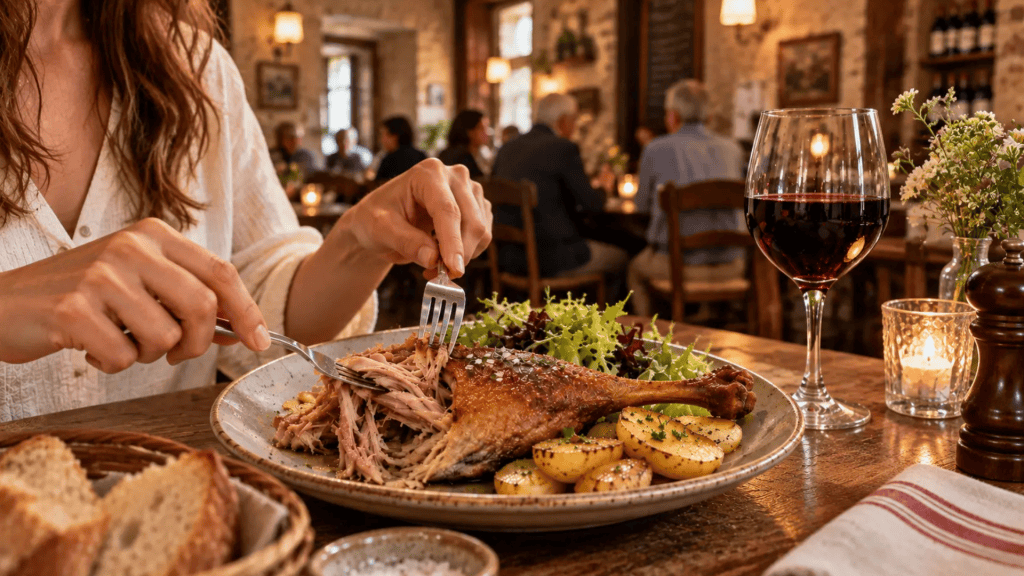
If foie gras is the region’s luxury, duck confit is its comfort food. Duck legs are salted, then slow-cooked and preserved in their own fat until the meat falls away from the bone with no resistance at all. It has been made this way since long before refrigeration existed, back when preserving meat in fat was simply how a household got through winter. You will usually find it served alongside pommes sarladaises, potatoes fried in duck fat with garlic and parsley, which tells you everything about how seriously this region takes duck fat as an ingredient in its own right. Magret, the seared duck breast, is the leaner alternative: pink in the middle, often finished with a fig or honey glaze. Between confit and magret, you are covering most of what a Dordogne kitchen considers a proper main course.
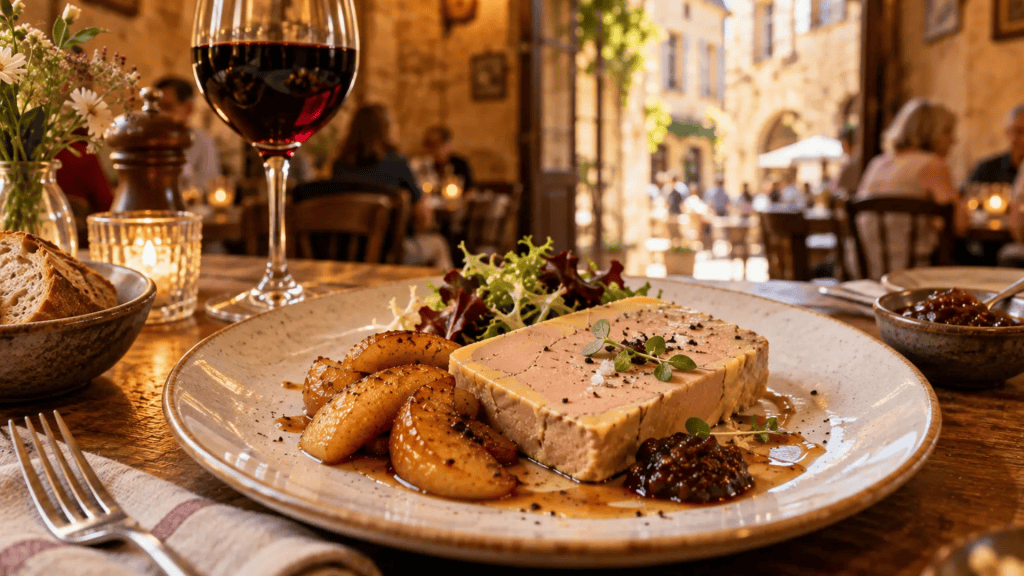
Estates and châteaux across the region put their own spin on this pairing. At Manoir de Longeveau, on the Charente-Dordogne border, duck confit and a Bergerac red regularly appear on the table during wedding weekends and family stays, which is about as concentrated a dose of local flavour as you will get without leaving the grounds.
3. Pommes Sarladaises, Potatoes Cooked in Duck Fat
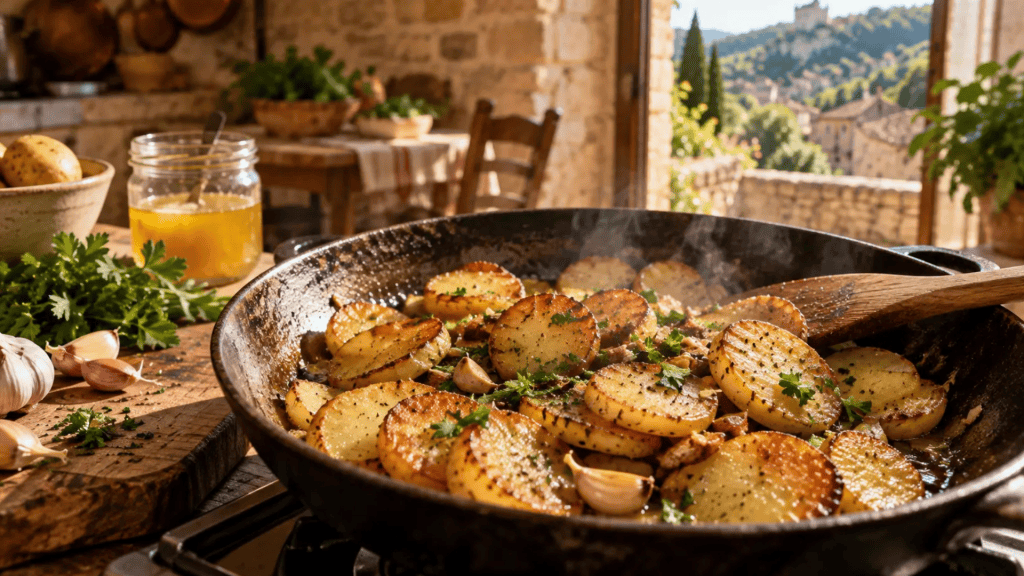
Named after Sarlat, these are potatoes sliced thin and slowly browned in duck or goose fat with garlic and parsley until the edges turn dark gold and slightly crisp. It sounds like a side dish. In practice, it is closer to a regional identity. Ask a local what makes Périgord cooking different from the rest of France and pommes sarladaises will come up before foie gras does, because this is the dish that turns up at family tables, not just restaurant menus. It is the dish people cook on an ordinary Tuesday, not just save for a special occasion, and that is the real difference between a regional specialty and a regional habit.
4. Salade Périgourdine, the Whole Region on One Plate
A Salade Périgourdine layers smoked duck breast, slices of foie gras, duck gizzards, walnuts and croutons over lettuce, finished with walnut oil and sometimes a raspberry vinegar. It reads like excess on paper. On the plate, the bitterness of the greens and the acidity of the dressing keep the richness in check, which is exactly why it works as a starter rather than a main.
Duck carries the Dordogne’s reputation, but it does not explain all of it. Some of the region’s most prized ingredients never come from a farm at all. They are dug up or foraged from the ground itself.
5. Black Périgord Truffles, the Region’s Black Diamond
Tuber melanosporum, the black Périgord truffle, is hunted rather than harvested. Trained dogs work oak and hazelnut groves through the winter months, and the truffle hunters who follow them can tell you exactly which tree produced last year’s best specimens. Truffle season runs from December to February, and Sarlat’s January truffle festival draws chefs and serious buyers who taste, smell and haggle over kilos that would have sold for a fraction of the price a century ago, when truffles were far more abundant. A kilo can fetch anywhere from €600 to €1,500 depending on size and season, which is part of why hunters guard their oak groves like family secrets. A few grams shaved over scrambled eggs or risotto is enough to change the dish entirely. This is not a truffle you drown a plate in. It is a truffle you use sparingly, because the aroma does the work the quantity cannot.
6. Omelette aux Cèpes, a Simple Forest Dish
Cèpes are porcini mushrooms, foraged from the region’s oak forests through autumn, and the simplest way to eat them is also the best: a plain omelette, cooked gently with a little garlic and parsley, letting the mushroom’s earthy flavour take over completely. It is unfussy in a way that surprises people expecting every Dordogne dish to be built around duck fat and luxury ingredients. This one is proof that the region’s cooking has a rustic register as well as a rich one, and that some of its best food asks for almost nothing beyond good produce and a hot pan.
7. Périgord Walnuts and Walnut Oil, an Ancient Harvest
Walnut trees have grown along the Dordogne river since Roman times, and the Noix du Périgord carries its own AOC designation, the kind of protected status usually reserved for wine. One regional cooperative alone handles around 4,000 tonnes of walnuts a year from more than 500 growers spread across the Dordogne, Lot and Corrèze, and the Dordogne département on its own out-produces every other walnut-growing region in France, which is why the walnuts on any autumn market stall are almost always that year’s harvest, not last year’s. The nuts themselves turn up everywhere, in salads, cakes and the classic tarte aux noix. Fine on their own. But the more interesting product is the oil. Traditionally pressed in stone mills, walnut oil has a depth that plain olive oil cannot match, and locals drizzle it over cheese, roasted vegetables and vinaigrettes rather than treating it as an occasional garnish. Autumn is walnut season, and villages across the Dordogne valley still hold walnut fairs where farmers sell the fresh harvest alongside oils, liqueurs and nougatine made from the same trees.
What comes next owes less to the forest and more to the kitchen shelf, cheese, cured pork and a soup that has fed this region longer than truffles have been fashionable.
8. Rocamadour and Cabécou, Small Goat’s Cheeses With AOP Status
Rocamadour is the most famous of the region’s small goat’s milk cheeses, an AOP-protected cabécou made on the limestone plateaus of the Lot since the fifteenth century. It is barely bigger than a coin, matured for only a few days, and the result is a cheese with a soft rind and a creamy, faintly nutty centre. Warm it on toast with a drizzle of honey and walnuts, or fold it into a Salade Périgourdine for a lighter alternative to the duck-heavy version. Cabécou more broadly refers to any small round goat cheese from the region, and you will find variations on market stalls in Périgueux and villages well beyond it that never make it onto a supermarket shelf.
9. Enchaud Périgourdin, the Dish Locals Actually Cook
This is the dish most visitors have never heard of and most locals grew up eating. Enchaud is pork loin, rubbed with garlic and thyme, slow-roasted, then left to cool in its own fat. The texture lands somewhere between a roast and a terrine. It is traditionally made with cul noir limousin pork, a breed that nearly disappeared in the 1970s before a small number of breeders brought it back. Enchaud is usually served cold or at room temperature, sliced thin, which makes it a fixture at markets and picnics rather than restaurant tasting menus. If you want to eat like a local household rather than a tourist itinerary, this is the dish to ask for by name.
10. Tourin, a Rustic Garlic Soup
Tourin is Périgord’s answer to French onion soup: a garlic soup, thin and warming, traditionally finished by whisking in egg white at the last minute so it sets into soft ribbons through the broth. It is old, rustic, and unpretentious in a way that stands out against foie gras and truffles, and it is the dish that tells you most about how this region actually eats on an ordinary Tuesday rather than a market Saturday. Some versions add a splash of vinegar or a piece of stale bread at the bottom of the bowl. An old habit. Nothing went to waste in a Périgord kitchen.
The closest thing the Dordogne has to a special occasion, food-wise, is the point in the year when the fruit and the wine are both at their best at once.
11. Fraises du Périgord, the Region’s Sweeter Side
The Dordogne valley produces some of France’s most sought-after strawberries, grown between the vine rows since long before tourism arrived. Varieties like Gariguette and Charlotte appear on market stalls from April through to October, sold by growers who have usually picked them that same morning. They are sweeter and more fragrant than anything shipped in from further south, and locals eat them plain, in a light tart, or splashed with a little vin de noix, the region’s walnut liqueur. If you are visiting in late spring, the strawberry stalls in a village like Aubeterre-sur-Dronne are worth building a morning around.
12. Bergerac and Monbazillac Wines, Sweetened by River Mist
Bergerac sits close enough to Bordeaux to share the same grape varieties, merlot, cabernet franc and sémillon among them, but the wines cost a fraction of their famous neighbour’s prices. The Bergerac vineyard covers roughly 12,000 hectares across 93 communes and 13 separate AOCs, and around 15% of it is already exported to Britain, Belgium, Germany and the Netherlands, so plenty of people have found their way here without going through Bordeaux first. Reds are full and food-friendly, whites are crisp, and Monbazillac, the region’s celebrated sweet wine, has been paired with foie gras since the sixteenth century for good reason. Its sweetness comes from noble rot, a fungus called Botrytis cinerea that thrives in the autumn mist rising off the Dordogne, shrivelling the grapes and concentrating their sugar before the afternoon sun burns the fog away. A handful of vineyards around Bergerac offer tastings, and a bottle of local red is the natural finish to almost every dish on this list, from duck confit to enchaud. If you try nothing else from this article, at least leave with a bottle of something local rather than something you could have bought at home.
Knowing all twelve is one thing. Knowing what to order if you can only manage one is another.
What to Order If You Only Have One Meal
Order the Salade Périgourdine. It puts smoked duck breast, foie gras, walnuts and a proper Périgord-style dressing on one plate, which means you are tasting four of the region’s defining ingredients without sitting through four separate courses. Add a glass of Bergerac red and you have covered duck, walnuts and the local wine in a single sitting. Everything else on this list rewards a longer stay. This is the one dish built for a short one. That still leaves the question of timing, since even the right dish depends on turning up in the right month.
When Is the Best Time to Try These Specialities?
Truffle season runs December to February, walnuts are harvested through September and October, and strawberries run from April to October at their sweetest in late spring. Timing decides more about what actually lands on your plate than any menu choice does. The Sarlat truffle festival in January draws hunters, dogs and serious buyers, the town’s Périgord goose festival follows in March, and village walnut fairs sell the fresh autumn crop alongside oils and liqueurs. If your trip lines up with any of these, you are tasting the region at the exact moment it is proudest of itself.
None of this requires a tasting menu or a reservation months in advance. Most of it is sitting on a market stall, a farmhouse table, or a menu written in chalk. The Dordogne’s food has never needed dressing up to make its case, and the dishes that have lasted this long, enchaud, tourin, a good Salade Périgourdine, have lasted because they were built to be eaten often, not admired occasionally. Go looking for the obvious specialities and you will find them everywhere. Go looking for the ones that rarely get written about, and you will understand why people who actually live here still bother to cook this way at all.
Manoir de Longeveau — 35 self-catering gîtes with heated pools, on-site golf and tennis, minutes from Aubeterre-sur-Dronne.
Browse the gîtes