Most people visiting the Dordogne with an interest in prehistoric art head south, toward Les Eyzies and the Vézère Valley, where the famous sites cluster. That is a reasonable instinct. Lascaux is there, Font-de-Gaume is there, and the valley has been a centre of prehistoric discovery for well over a century. But in the northern Dordogne, about fifty minutes from Longeveau in the green hills of the Périgord Vert, there is a cave that those same visitors tend to miss entirely and, in the view of many people who have been to both, should not.
The Grotte de Villars holds a distinction that no other cave in the Périgord can claim. It is the only one in the region that contains both original prehistoric paintings and the full range of natural calcite formations – stalactites, stalagmites, draperies, pillars and the strange twisted spurs known as ‘eccentrics’ – in the same underground space. The two things together, the human art and the geological spectacle, make for an experience that is qualitatively different from a cave that offers one or the other.
How the Cave Was Found
The discovery of the Grotte de Villars follows the pattern of many significant prehistoric finds in this region, which is to say that chance played a considerable part in it. During the winter of 1953, members of the Périgueux caving club noticed condensation escaping from what appeared to be a fox den on a hillside in the commune of Villars, in the northern Dordogne. Condensation from a small hole in the ground is a reliable indicator that a significant underground void lies below, and the club investigated. What they found was the entrance to a cave system that would eventually prove to extend for nearly thirteen kilometres.
The bear scratch marks along the entry passage were noticed in 1956. The paintings themselves were identified in 1957 by Pierre Vidal, a member of the speleology club, during a deeper exploration of the cave. Their authenticity was subsequently confirmed by Abbé Breuil, the French Catholic priest and prehistorian who had spent decades investigating and authenticating cave art across the Périgord. The cave was opened to the public for the first time in 1959 and has been in the care of the Versaveaud family ever since.
What the Guided Tour Shows You
The section of the cave open to visitors covers around 600 metres of the total thirteen-kilometre system, guided at a steady pace over approximately forty-five minutes to an hour. The guides speak English and are consistent in their ability to make the geology and the prehistory accessible to visitors of all ages and levels of prior knowledge.
The tour passes through a sequence of chambers and galleries that open and close around you as you descend to around forty metres below the surface. The cave maintains a constant temperature of thirteen degrees Celsius throughout the year, which is refreshing in summer and noticeably cold in October. The advice to bring a jacket is genuine and worth following.
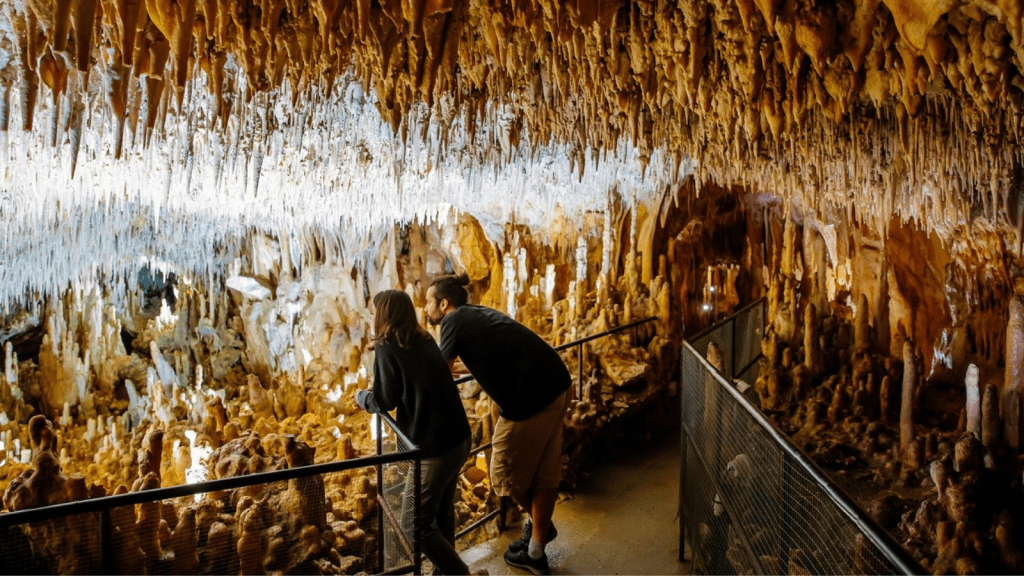
The geological formations begin almost immediately. The vaults, walls and floors are layered with calcite in almost every form it takes. Fine stalactites hang from the upper galleries in such density that they create a visual texture more like fabric than stone. Stalagmites rise from the floor in varying heights and colours, some translucent, some stained ochre and rust by mineral content in the water that formed them. The calcite draperies, thin sheets of stone that fold and hang from the walls like frozen curtains, are among the most delicate natural formations visible anywhere in the Périgord. At the deepest point of the tourist route, a sound and light installation traces the evolution of the cave over two hundred thousand years, evoking both the underground river that carved the chambers and the presence of the cave bears that used the space for hibernation long before any human entered it.
The bear claw marks are one of the more affecting things in the cave and are easy to underestimate before you see them. Long parallel scratches in the soft limestone wall at shoulder height, made by bears raising themselves to their full height: they are not marked or labelled in any elaborate way, and that directness is part of what makes them work. There is also evidence of bear hair found in the cave during excavation. These animals were here before the painters, and the cave holds both presences simultaneously.
The Paintings

Thirty paintings have been identified in the Grotte de Villars, distributed across the salle des cierges and the salle des peintures in the ornate section of the cave. They were made approximately nineteen to twenty thousand years ago, during the Lower Magdalenian period, in black manganese oxide bound with animal grease. They are not large. None exceeds fifty centimetres. But what happened to them in the millennia since they were made is part of what makes them extraordinary.
A thin layer of calcite has formed over most of the paintings, a slow accumulation of mineral deposit from the seeping water that has been building since the cave was sealed. This calcite coating has done two things simultaneously: it has preserved the paintings from external degradation, and it has turned them blue. The famous little blue horse of Villars is the most celebrated example of this effect, the animal’s outline visible through a milky translucent veil that gives it a quality unlike anything in surface-based art from any period. The horse rotunda, where several painted animals appear together, is the primary destination within the painted section of the cave.
The scene known as ‘the bison and the sorcerer’ is the other image that tends to stay with visitors longest. It depicts a bison and a human figure together, one of the very rare instances in all of prehistoric cave art in which a person is represented. Similar scenes exist in only a handful of caves worldwide, including in the well of Lascaux, and the Villars version has been extensively studied by prehistoric art specialists. Whether the human figure is being attacked by the bison, or whether the relationship between the two forms means something entirely different, is a question that the paintings themselves do not resolve. That ambiguity is part of what makes prehistoric art compelling rather than simply old.
No photography is permitted inside the cave. This is standard at sites with original prehistoric art, and for good reason: flash photography, and even the heat and moisture generated by camera equipment, can accelerate surface change in fragile geological and painted surfaces. The instruction is enforced and is worth accepting gracefully. The paintings are better seen in person than in a photograph in any case.
Outside the Cave

The Cro-Magnon garden that extends from the cave entrance across the hillside around it is worth more time than many visitors give it. It is an outdoor educational space that reconstructs the plant environment of the Magdalenian period and contextualises the life of the people who painted the cave walls, with information boards, displays, and in summer a programme of activities that includes stone-throwing with reconstructed Palaeolithic thrusters and cave painting workshops for children. These run on weekday afternoons in July and August and are free with cave admission. They are better than they sound, in the way that hands-on activities for children in well-designed outdoor spaces often are.
There is a café and snack bar at the site, a picnic area, and a small shop with a well-stocked selection of geology books, children’s materials, and mineral specimens. A short film about the cave’s discovery and formation runs near the exit and is worth ten minutes if you have them.
Practical Information
The Grotte de Villars is open every day from 31 March to 3 November. From April through June and in September, it operates morning sessions from 10am to noon and afternoon sessions from 2pm to 6pm, with the last tour departing thirty minutes before closing. In July and August it runs continuously from 10am to 7pm. In October and November it opens in the afternoon only, from 2pm to 6pm.
Adult admission is €12. Children aged five to eleven pay €7.50, and twelve- to seventeen-year-olds pay €9. Students under twenty-five with a student card also pay €9. The cave is accessed by guided tour only, and groups are capped in size, which means that in peak summer weeks the morning sessions in particular can fill up. Booking online in advance through the Grotte de Villars official website is strongly recommended in July and August and is straightforward to do. The address is Le Cluzeau, 24530 Villars, and there is ample free parking at the site.
The drive from Longeveau takes around fifty minutes, passing through the Périgord Vert countryside into the northern Dordogne. Brantôme is about fifteen minutes from Villars, making the two a natural pairing for a day out. The cave in the morning, Brantôme for lunch and the afternoon, covers the ground without rushing either. The cave also sits on the edge of the Périgord-Limousin Regional Natural Park, and the roads through this part of the Dordogne are among the least travelled in the region.
The things to do in the surrounding area from Longeveau cover both the northern Dordogne and the wider Charente-Dordogne border in more detail. For the prehistoric cave enthusiast, Périgueux is also within easy reach, and the Vesunna Gallo-Roman Museum there provides a complementary perspective on the deep human history of this particular corner of France. If you are planning a stay and want to think through what to combine with a visit to Villars, the team at Longeveau is happy to help. Just get in touch.
Manoir de Longeveau — 35 self-catering gîtes with heated pools, on-site golf and tennis, minutes from Aubeterre-sur-Dronne.
Browse the gîtes