Périgueux does not shout. It is the capital of the Dordogne and has been a significant settlement for over two thousand years, but it carries this history without making a spectacle of it. Walk into the old town from a car park on the edge of the centre, and within five minutes you are standing in front of a cathedral that inspired the design of the Sacré-Cœur in Paris, looking up at domes you did not expect to find in a market town in southwest France. That is roughly the rhythm of Périgueux as a place. It keeps surprising you.
From Longeveau, the drive to Périgueux takes about forty-five minutes. As day trips go, it is one of the most rewarding in the area, and the city repays a full day if you can give it one, though a morning into afternoon covers the main things comfortably without feeling rushed. This guide covers what to see, where to eat, and how to arrange the day sensibly.
Start at Cathédrale Saint-Front
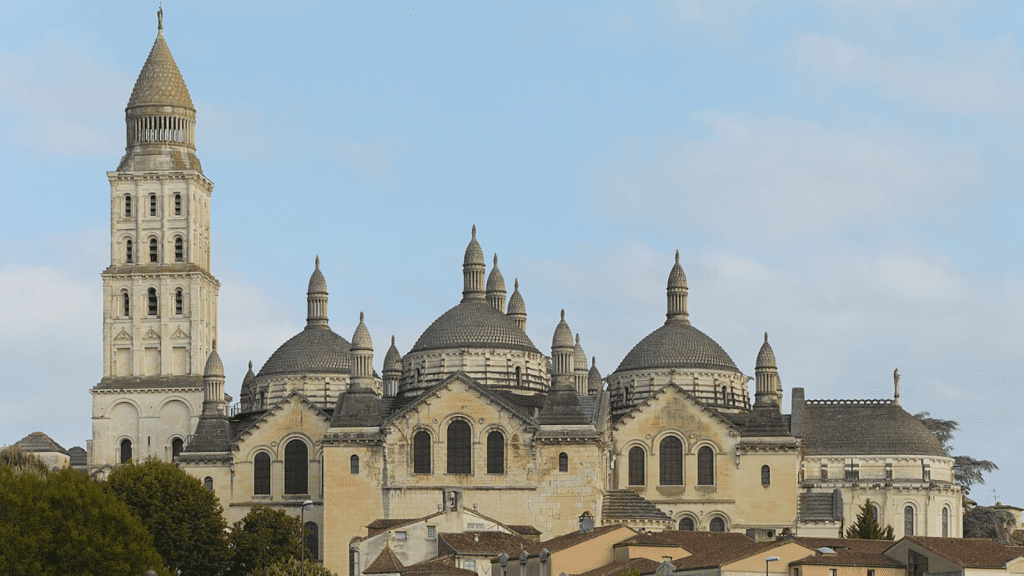
The cathedral is the obvious starting point, and it is obvious for good reasons. Cathédrale Saint-Front is the dominant landmark of Périgueux, its five domed cupolas visible from most of the surrounding city, and standing in front of it for the first time produces a moment of genuine surprise in most visitors. The Byzantine domes and the white stone tower are not what French cathedral architecture normally looks like, and the explanation for that is a story worth knowing.
The original Romanesque church on this site dates to around 1120. In the nineteenth century it was substantially remodelled by the architect Paul Abadie, who replaced the Romanesque roofline with the Byzantine domed structure visible today. Abadie then used Saint-Front as his model when he won the competition to design the Sacré-Cœur basilica in Montmartre a few years later, which is why the two buildings have such a strong family resemblance. The original design was apparently preferred by locals and architects who found the changes too theatrical, and the debate about what was lost in the reconstruction has not entirely died down. The building as it stands is extraordinary regardless of where you land on that argument.
Saint-Front sits on one of the four main French pilgrimage routes to Santiago de Compostela, the Voie de Vézelay, and is part of the UNESCO World Heritage designation that covers the routes of Santiago de Compostela in France. On a typical morning there will be a pilgrim or two inside, stamps being collected before the next stage. Inside the cathedral the space is genuinely impressive, with the domed vaults creating a quality of light that is very different from a conventional nave.
Collect a free walking map from the tourist office, which is near the cathedral, before setting off into the mediaeval quarter. It is one of those maps that actually earns its keep.
The Medieval Quarter

The mediaeval centre of Périgueux is compact enough to cover on foot in a morning and interesting enough to justify taking your time over it. The streets cluster around and below the cathedral, are mostly pedestrianised, and contain some of the best-preserved Renaissance and mediaeval architecture in the Dordogne.
Rue Limogeanne is the street most visitors settle on as a favourite. It runs south from near the cathedral through the old town and is lined with a mix of mediaeval and Renaissance buildings, many of them carefully restored, with the sort of proportions and detail that makes you stop and look properly at things you might otherwise walk past. The overhanging upper storeys, the carved doorways, and the occasional interior courtyard glimpsed through an archway are what make this street work.
Nearby, the Tour Mataguerre is all that survives of the defensive wall that once enclosed the mediaeval town. The original circuit had twenty-eight towers and twelve gates, and the single remaining tower, with its cannon ports and archery slits, gives a clear sense of what the fifteenth-century fortification would have looked like at its full extent. Place de Navarre just beyond it has sixteenth-century buildings on three sides and provides a natural pause in the walk.
On Rue du Plantier you can find the House of the Ladies of the Faith, a twelfth-century building that has survived in reasonable condition. On Rue de la Constitution a couple of houses retain their half-timbered upper floors, a construction technique that has largely disappeared from this part of France. The Maison du Patissier on Place Saint-Louis is another notable stop, a fourteenth-century building with a Renaissance doorway crowned by a scallop shell, the symbol of the Camino pilgrimage.
The Quartier des Arts, where the older Collégiale Notre-Dame stands, has several artists’ workshops and small galleries tucked around it and is worth a brief detour if you have the time.
The Vesunna Gallo-Roman Museum

A ten to fifteen minute walk from the mediaeval quarter, past the remains of the Roman amphitheatre that now form the perimeter of a public garden, brings you to one of the most architecturally interesting museums in the Dordogne. The Vesunna Gallo-Roman Museum is built around the excavated remains of a wealthy Roman townhouse, a domus, discovered in 1959 and since classified as a French historical monument.
The building that houses it was designed by Jean Nouvel and opened in 2003. Nouvel’s approach was to protect the site without burying it: the result is a large glass and steel structure that sits above the ancient walls like a roof, keeping the weather out while keeping the archaeology visible. Standing inside the museum, you look down onto two-thousand-year-old painted plaster walls from elevated walkways, and the glass perimeter of the building frames the Tour de Vésone, the tower of the ancient Roman temple, in the park outside. The building has won awards, and it deserves them. It makes the archaeology feel immediate rather than preserved.
The permanent collection covers city and public life in the Roman settlement, as well as the private life of the domus itself. There are mosaics, carved inscriptions, objects of daily use, and a striking fresco of marine life from the second century. Audio guides are available in English, and the museum is accessible throughout. Allow a minimum of an hour, more if you are genuinely interested in the period or have children who respond to the interactive elements.
The Tour de Vésone stands in the park immediately outside the museum. It is the remains of the cella, the inner sanctum, of a Roman temple that once stood at the centre of the ancient city and rises to over twenty-four metres. Walking around it before or after the museum gives a useful sense of the scale of the settlement that preceded the mediaeval town by more than a thousand years.
The Market and Where to Eat
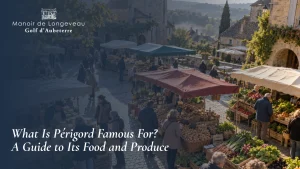
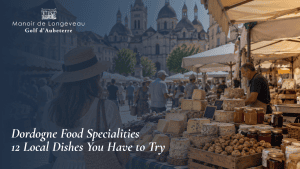
Périgueux holds its main street market on Wednesday and Saturday mornings at Place du Coderc and Place de la Clautre, two squares in the heart of the old town. If you can arrange your visit around a Wednesday or Saturday morning, the market adds considerably to the day. Produce from the surrounding Périgord countryside, cheese, bread, charcuterie, and the full range of duck and foie gras products that define this region’s food culture are all present, and the squares are at their most animated. From November through winter, the market also includes a speciality foie gras and fattened poultry section, and truffles from the Périgord appear in quantity from December through February.

If the market is not running, the covered Halles du Coderc on the same square operates daily and carries much of the same produce in a permanent setting.
For lunch, Périgueux has a good range of options concentrated around the old town. L’Essentiel is consistently well-regarded for French cooking with local ingredients and sits at the quieter, more considered end of the spectrum. Hercule Poirot offers a different register, a little more inventive in approach, and has a good reputation for menus that change with what is available locally. Both benefit from booking ahead in summer. For something simpler, the café terraces around Place du Coderc and Place de la Clautre are the natural choice, particularly on a market morning when the atmosphere sustains itself until early afternoon.
How to Arrange the Day
The simplest approach is to park near Place Francheville on the edge of the old town, which is central and convenient, and then walk from the cathedral southward into the mediaeval quarter before crossing to the Vesunna Museum in the afternoon. This order of things makes geographical sense and allows you to see the mediaeval town while you have the most energy, then settle into the slower pace of the museum after lunch.
Most visitors find four to five hours covers everything comfortably. If you push it to six hours and add a proper lunch and some time in the market, you have used the day well. Périgueux is not a city that requires an overnight stay to see, but it is also not a city you want to feel hurried in, and giving yourself enough time to sit down somewhere pleasant for an hour rather than rushing from one sight to the next makes a significant difference to the experience.
It pairs naturally in a week’s itinerary with Ribérac on a Friday morning and Aubeterre-sur-Dronne at any time. All three are within comfortable reach of Longeveau and offer very different but complementary experiences of this corner of France. For a broader picture of what is available in the area during a stay, the places-to-visit page covers the full range. And if you are planning a trip and want to think through how to structure the days, the team at Longeveau is always happy to help. Just get in touch.
Manoir de Longeveau — 35 self-catering gîtes with heated pools, on-site golf and tennis, minutes from Aubeterre-sur-Dronne.
Browse the gîtes