It depends on what you are looking for. If you want the kind of French market that feels genuinely local rather than arranged for visitors, with producers who have driven in from the surrounding countryside, conversations happening across stalls, and the whole town briefly transformed into something considerably livelier than its usual self, then yes, the Ribérac Friday market is absolutely worth the drive from Longeveau. If you are hoping for a polished artisan market with carefully curated stalls and a view of a mediaeval square, you might be better placed elsewhere.
That distinction is not a criticism. The Ribérac market is often described as the largest in the Périgord, and what makes it worth visiting is precisely that it has not been softened or styled for tourism. It is a working market serving the communities of the northern Dordogne, and it has been doing so, in one form or another, for a very long time.
What the Market Actually Looks Like

Ribérac sits about thirty minutes southeast of Longeveau in the rolling farmland of the northern Dordogne, and for most of the week it is a quiet town with a pleasant high street, a couple of good churches, and not much reason to stop unless you already know someone there. On Friday mornings, it is entirely different.
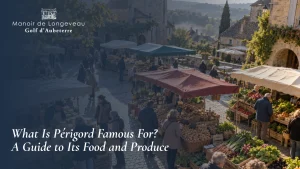
The market fills the town centre across multiple streets, spreads into the squares, and takes a proper circuit to cover. The food section and the general market run alongside each other without a clear boundary between them, which means a walk around the whole thing tends to take longer than expected. Most regular visitors allow at least ninety minutes, and two hours is not unusual if you stop to talk to stallholders, taste anything, or find yourself in the cheese section.
The food stalls are the heart of it. Local producers bring vegetables that were in the ground earlier in the week, cheeses from farms within a short drive, bread from local bakers, charcuterie from producers who have been coming to the same spot for years, and fish bought in fresh that morning. There are meat stalls with whole ducks and geese hanging, a rotisserie chicken operation that fills the surrounding streets with the kind of smell that makes it very difficult to walk past, and a paella pan that tends to develop a small crowd around it by mid-morning.
The market runs from 8am to 1pm every Friday morning, all year round.
The Food Worth Knowing About
The Dordogne sits at the centre of one of France’s great food cultures, and the Ribérac market reflects that without making a performance of it. Foie gras, duck confit, rillettes and walnut oil appear naturally alongside the everyday produce rather than being separated into a speciality section. Honey from local hives, jams made from fruit grown nearby, and seasonal vegetables that shift through the year with the rhythm of what is actually ready rather than what is always available are what define the food stalls here.
The cheese selection consistently draws praise. The Périgord is not the most famous cheese region of France, but the variety at Ribérac on a Friday morning can surprise people who are not expecting it, with farm-made goat cheeses alongside larger rounds and some excellent truffle Brie from stalls that know their market well.
Between November and March the market gains a specific dimension that changes its character considerably. The winter truffle market operates in the Salle Polyvalente during this period, a separate morning market where black truffles from the surrounding countryside are bought and sold by producers and buyers who have been making the same transaction for generations. If you are visiting in winter and have any interest in truffles, this alone justifies the drive. There is also an autumn nut market at Place André-Pradeau, where the walnut harvest from the region’s orchards arrives in volume. Between May and September a fresh farm produce market at Place de la Liberté adds to the Friday morning offer, and in July and August an arts and crafts evening market runs alongside the regular Friday operation.

Beyond the Food
The general market runs through the same streets as the food section, and the two blend into each other as you walk. Clothing, linens, pottery, kitchen equipment, plants, books, garden tools, children’s toys, and a section that seems to contain a little of everything that does not fit anywhere else are all represented. It is not a market you go to for carefully crafted artisan goods, and a few reviewers note that the number of artisan stalls has reduced over the years. What you do get is the feeling of a proper mixed market of the kind that has become increasingly rare, where the agricultural and the domestic sit alongside each other in the way they always did before markets began to specialise.
The atmosphere is the part that is hardest to describe and most worth going for. By around 9am the town is fully alive with the sounds and movement of several hundred people going about a Friday morning that happens to involve buying vegetables in a way that has not changed much in generations. The café terraces around the square fill up with people who have finished their shopping and are in no particular hurry to be anywhere else, and the whole thing has an ease to it that is specific to market towns in this part of France. Ribérac is genuinely not polished for tourists, and the atmosphere is considerably better for it.
Practical Things to Know
Parking is the detail that most visitors mention first, and the advice is consistent: arrive before 9am. The town centre fills up quickly once the market is properly underway, and the walk from the more distant parking areas is not a hardship, but it is longer than expected. Getting there closer to 8am gives you the quietest version of the market, the best choice at the food stalls, and a car park you can actually get into without circling.
The market is year-round and largely weather-resistant. Ribérac does not shut the market down for rain, and the rhythm of it continues through the winter months with the addition of the truffle market making December and January particularly interesting. Cold weather in January with a truffle market in full swing is a genuine Dordogne experience that is entirely different from the summer version and no less worth having.
Most stallholders are local, and French is the language of the market, though the town has a long relationship with British visitors and residents, and English is not uncommon. Prices are fair and generally lower than equivalent produce in tourist-orientated markets elsewhere in the region.
If you have filled your bags and want somewhere to sit down, the cafés around the central square are the natural next step. The atmosphere on a Friday morning makes a coffee or a glass of something here one of the more pleasant ways to spend half an hour in the Dordogne. A few of the restaurants near the market are open for lunch from around noon and provide a natural endpoint to the morning if you want to make a full occasion of it.

What to Do With the Rest of the Day
Ribérac on a Friday morning is the town at its absolute best. For the rest of the week it is quiet and pleasant but does not have the individual attractions to sustain a long visit on their own. The two churches in the centre, particularly the twentieth-century Notre-Dame de la Paix with its neo-Romanesque slate domes and the older Collégiale Notre-Dame in the Quartier des Arts, are worth a look. The town hall building and its surrounding park are attractive, and the high street has a few good independent shops. But the honest answer is that if you have come specifically for the market and it is not a Friday, there is not a great deal holding you there for more than an hour.
The surrounding area is a different matter. The northern Dordogne has some excellent Romanesque churches scattered across the small villages south and east of Ribérac, and the tourist office has a circuit map covering them if that is your thing. The Forêt de la Double to the west is a large and genuinely wild forest with lakes and quiet roads, worth an afternoon if you like that kind of country.
Aubeterre-sur-Dronne is about thirty minutes back toward Longeveau and makes a natural pairing with a Friday morning at the market: the market first, then a slow lunch in the square at Aubeterre, and the underground church in the early afternoon before heading back. The two together make one of the better days out available from a base in this part of France without requiring any particular effort to organise.
For ideas about how to structure days out from the estate across the week, the places to visit page has more detail on what is within reach. And if you are planning a stay and want to know what a typical week in the area looks like, the team at Longeveau is happy to talk through options. Just get in touch.
Manoir de Longeveau — 35 self-catering gîtes with heated pools, on-site golf and tennis, minutes from Aubeterre-sur-Dronne.
Browse the gîtes