The best cheeses to try in South West France are Roquefort, Ossau-Iraty, Rocamadour, Laguiole and Tomme des Pyrénées, plus one walnut-washed abbey cheese from the Dordogne that most guides skip.
The catch is that the famous ones sit a long way from the Charente and Dordogne. Several are also made with raw milk, which changes the answer if you are travelling with a toddler or expecting a baby.
What are the best cheeses to try in South West France?
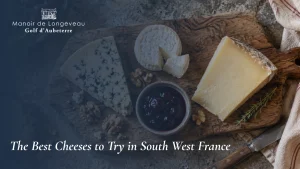
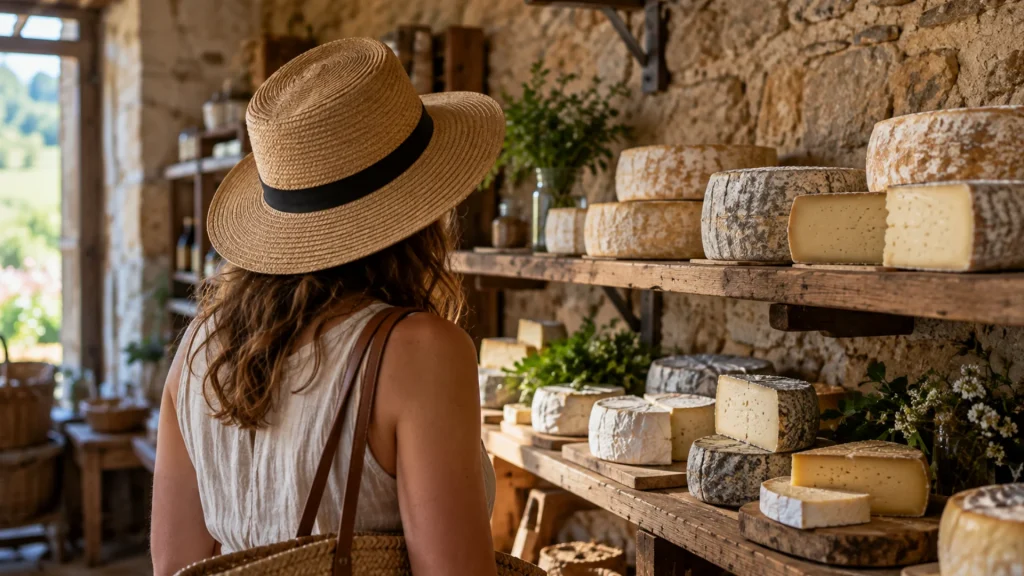
The best cheeses to try in South West France are Roquefort, Ossau-Iraty, Rocamadour, Laguiole and Tomme des Pyrénées. Between them they cover sheep, goat and cow’s milk, from the Pyrenees to the Aveyron to the limestone plateaus of the Lot. Occitanie’s tourism board profiles Roquefort, Laguiole, Rocamadour and Tomme des Pyrénées in French.
Roquefort, the Blue With a Cave Behind It
The caves do the work. Roquefort is a raw sheep’s milk blue cheese, matured in the natural Combalou caves at Roquefort-sur-Soulzon in the Aveyron. In 1925 it became the first to receive an AOC (appellation d’origine contrôlée). The flavour is salty and pungent, with a crumbly, creamy texture, and a small piece goes a long way.
Ossau-Iraty, the Pyrenean Sheep’s Cheese
Black cherry jam from Itxassou is the traditional partner for Ossau-Iraty, which sounds wrong until you try it. The cheese comes from Béarn and the Basque Country and carries a protected designation of origin. It is a semi-hard, uncooked pressed cheese matured for 80 to 120 days, nutty and slightly sweet. Some wheels are made on farms with raw milk and others in dairies with pasteurised or heat-treated milk, so check which one you are buying.
Rocamadour, the Goat’s Cheese That Fits in Your Palm
Rocamadour weighs about 35 grams, a flat disc of goat’s milk cheese about six centimetres across with a thin, velvety rind, named after the cliff-side village in the Lot. It is an AOP cheese made only with whole, raw goat’s milk, mostly in the Lot with a few communes in the Dordogne. Young, it tastes creamy, with butter and cream notes and a faint goat tang. With age, it dries out and turns more powerful.
Laguiole, the Mountain Cheese Behind the Aligot
Aligot, the stretchy potato dish of the Aubrac, starts with the fresh curd that later becomes Laguiole, known as tome fraîche de l’Aubrac. Laguiole itself is a raw cow’s milk cheese from the Aubrac plateau, pressed and uncooked, then matured for at least four months, often far longer. The cows graze Aubrac pasture, and the flavour shows it: milky and buttery when young, fruity and hazelnut with age.
Tomme des Pyrénées, the Pyrenean Pressed Cheese
A black or gold wax coat usually marks a dairy-made Tomme des Pyrénées, a pressed cheese with an IGP, a lighter form of protection than an AOP. Those are usually made from cow’s milk, pasteurised, with a mild, milky flavour and a slight tang. Farm versions, made with raw milk, taste fuller.
Every one of those five is at least two hours’ drive from the Charente-Dordogne border, so the cheeses made closer to it, starting with the abbey’s walnut-washed Trappe, get their own section further down. You’ll also see Bleu des Causses, a cow’s milk blue from the causses next to Roquefort, and Pélardon, a small goat’s cheese from the Cévennes and Languedoc hills, on many regional lists.
What is the most famous cheese from South West France?
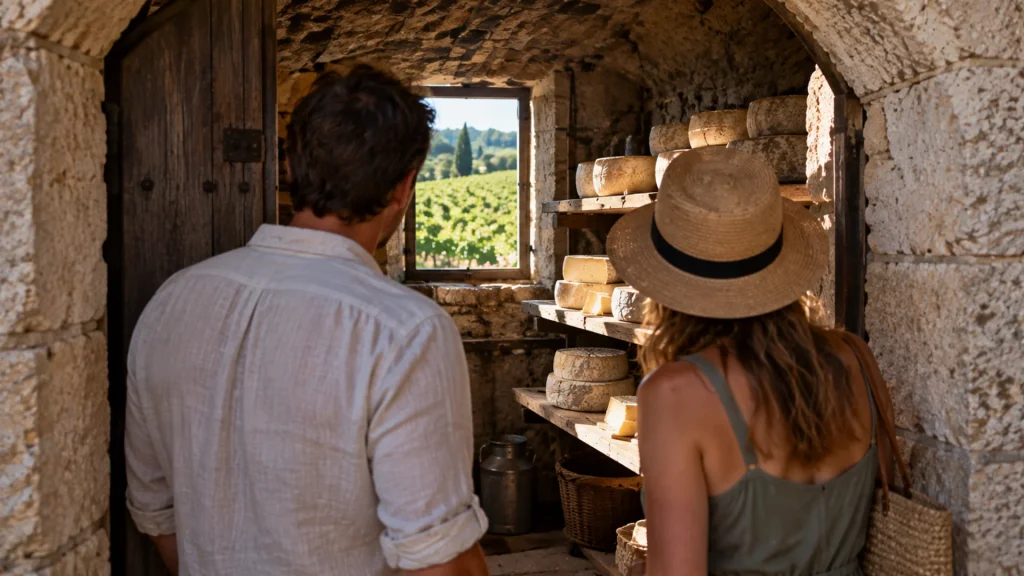
Roquefort. France calls it le roi des fromages, a nickname credited to Diderot (Brie de Meaux claims the same crown), and the region’s food tourism is built around it, thanks to those caves.
Fame and usefulness are different questions, though. Camembert, soft with a bloomy rind, belongs to Normandy, Brie de Meaux to the area east of Paris, Comté to Franche-Comté, Cantal to the Auvergne, and Reblochon and Beaufort to the Alps, in Auvergne-Rhône-Alpes. These are the famous French cheeses on every list, and none of them comes from the South West.
The cheese that tells you where you are is the one made nearest to where you are standing. In the Charente and Dordogne, that means a different set of names.
Which cheeses are made in the Charente and Dordogne?
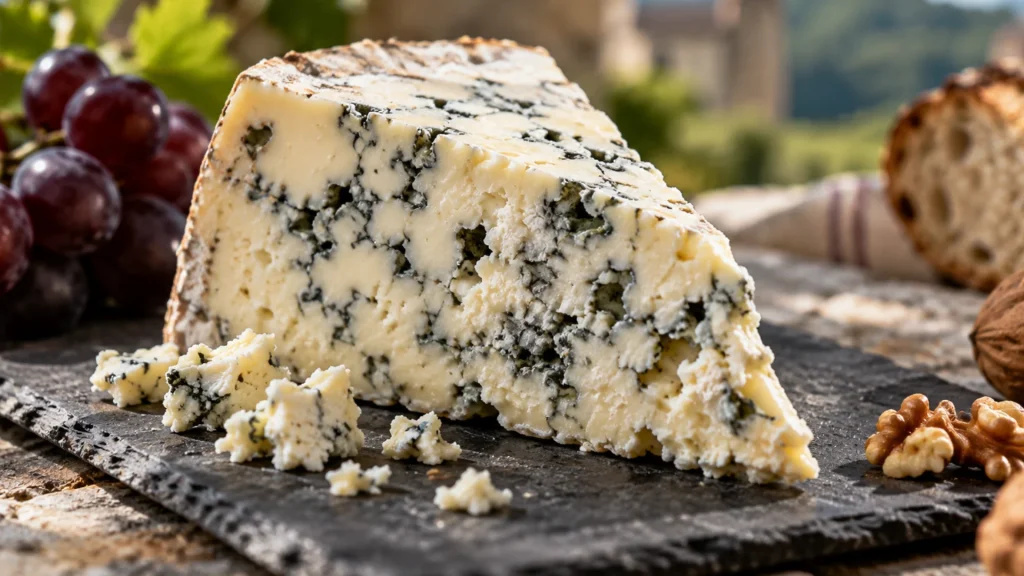
The ones to look for are an abbey cheese washed in walnut liqueur, the small cabécou goat cheeses of the Dordogne and, just north of the Charente, two goat cheeses from Poitou.
Trappe d’Échourgnac, the Walnut Cheese Made by Nuns
Trappe d’Échourgnac is made at the Abbaye Notre-Dame de Bonne Espérance in Échourgnac, in the Forêt de Double in the Dordogne. Cistercian nuns took over the abbey in 1923 and still make it in the Trappist tradition, from pasteurised cow’s milk, as a semi-soft, uncooked pressed, washed rind cheese. A second version, introduced in 1999, is washed in walnut liqueur from the Périgord and turns the rind dark brown. It matures for two to four weeks. Visitors can go into the abbey shop, the church and a small museum, but not the cheese dairy, the gardens or the monastic buildings.
Cabécou du Périgord, the Dordogne’s Small Goat Cheese
Cabécou du Périgord is the Dordogne cheese with its own collective trademark, held since 1992 by the goat producers’ trade body, and the name comes from Occitan. Dordogne farms keep more than 20,000 goats. Fresh, it is a soft, creamy cheese with a mild tang. Left to ripen for a few weeks, it grows a wrinkled rind and a firmer, sharper centre. We separate Cabécou from Rocamadour in our guide to Dordogne food specialities.
Chabichou du Poitou and Mothais-sur-Feuille, the Poitou Goat Cheeses
Goat cheese lovers usually look to the Loire Valley and Sainte-Maure de Touraine. South of the Loire, Poitou and the Charente have their own tradition. Chabichou du Poitou is a small, tower-shaped goat’s cheese with its own protected designation, creamy but slightly dry. Mothais-sur-Feuille is a round, soft chèvre matured on a chestnut leaf, made in a zone that includes the Charente.
What does a cheese course look like in South West France?
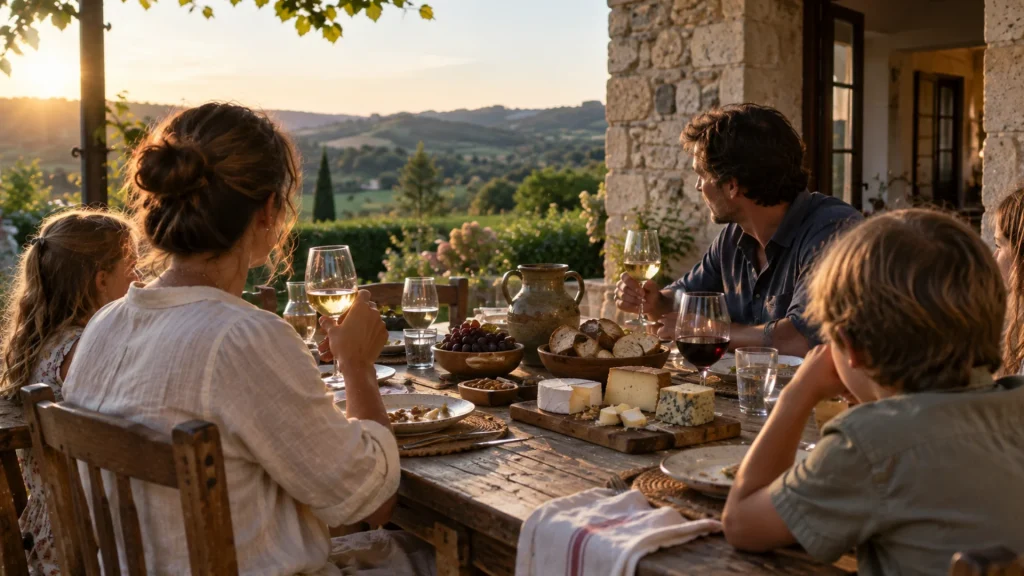
In a traditional French meal, cheese arrives after the main course and before dessert, as a plateau de fromage the waiter brings round or a board passed along the table. In a gîte, you’re the waiter.
Start with the mildest and finish with the strongest, so the pungent blue does not flatten everything after it. Take the board out of the fridge 30 to 45 minutes before serving, because cold cheese tastes of very little.
Three cheeses beat six. A cheese board of one goat’s cheese, one firm cheese and one blue shows range without turning dinner into homework. In this corner of France that could be a ripe cabécou, a wedge of Ossau-Iraty and a small piece of Roquefort or its Auvergne cousin, Bleu d’Auvergne. In the Dordogne, cabécou also turns up warm on a salad with candied walnuts or honey, served as a starter.
If you want to plan the courses around the board, our guide to the traditional food of South West France shows which dishes belong where.
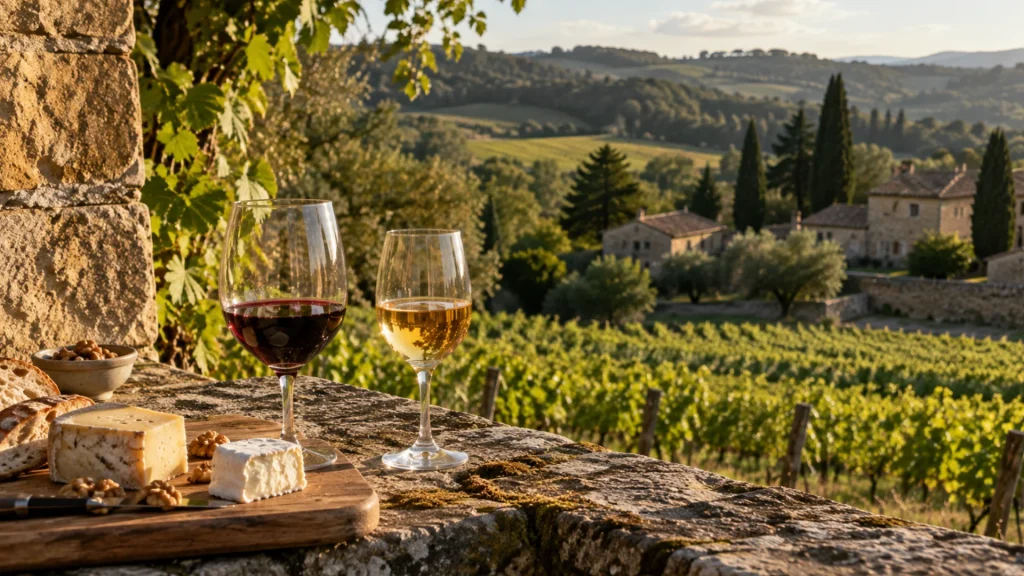
Which wines go with South West French cheeses?
Start with the terroir rule: cheese and wine from the same area tend to suit each other, because they grew up side by side. A sweet white is the classic partner for a salty blue.
| Cheese | Wine to try |
| Roquefort | Sauternes or a sweet Pacherenc du Vic-Bilh |
| Ossau-Iraty | Irouléguy or Jurançon |
| Laguiole | Marcillac |
| Rocamadour | Cahors or Coteaux du Quercy |
| Trappe d’Échourgnac | Cahors |
Closer to the Charente-Dordogne border, Bergerac is the obvious local bottle and Monbazillac the sweet one. Our guide to what Périgord is famous for explains both.
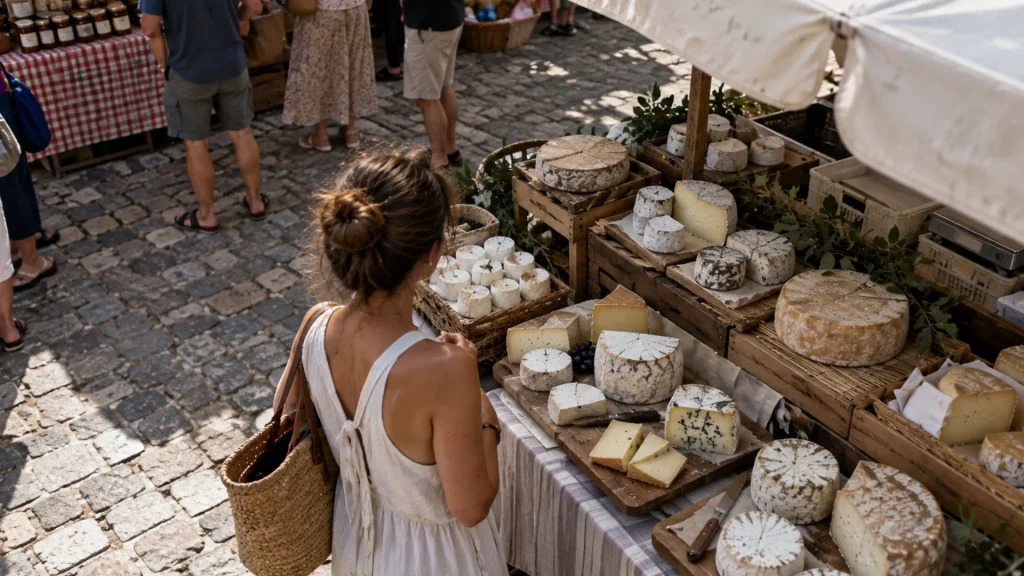
Where can you taste and buy local cheese in the Charente and Dordogne?
Start at the abbey. The Abbaye d’Échourgnac sells its cheese directly from its monastic shop. The shop closes for lunch and stays shut on Monday mornings, so go in the morning or mid-afternoon.
In France a cheese shop is a fromagerie, and Fromagerie Picandine, near Saint-Astier in the Périgord, is one: a goat’s milk dairy that makes cabécou-style cheeses, including the Picandou.
For markets, Aubeterre-sur-Dronne holds its weekly market on Sunday morning and Chalais on Monday morning. Ribérac’s main market runs every Friday morning all year, with a producers’ market there on Tuesday mornings from May to September, though market days can change. Look for the stall where the person selling made the cheese, and ask “lait cru ou pasteurisé?” (raw or pasteurised?), because the answer matters in the next section.
Manoir de Longeveau, a family-run estate on the Charente-Dordogne border, is about 10 minutes from Aubeterre-sur-Dronne, which puts the abbey about 30 minutes away and Fromagerie Picandine about 45. With 35 self-catering gîtes, you can turn a cheese morning into an easy half-day and build the board yourself from what you buy.
The village that gives Rocamadour cheese its name is roughly two and a half hours away, so plan it as a day out.
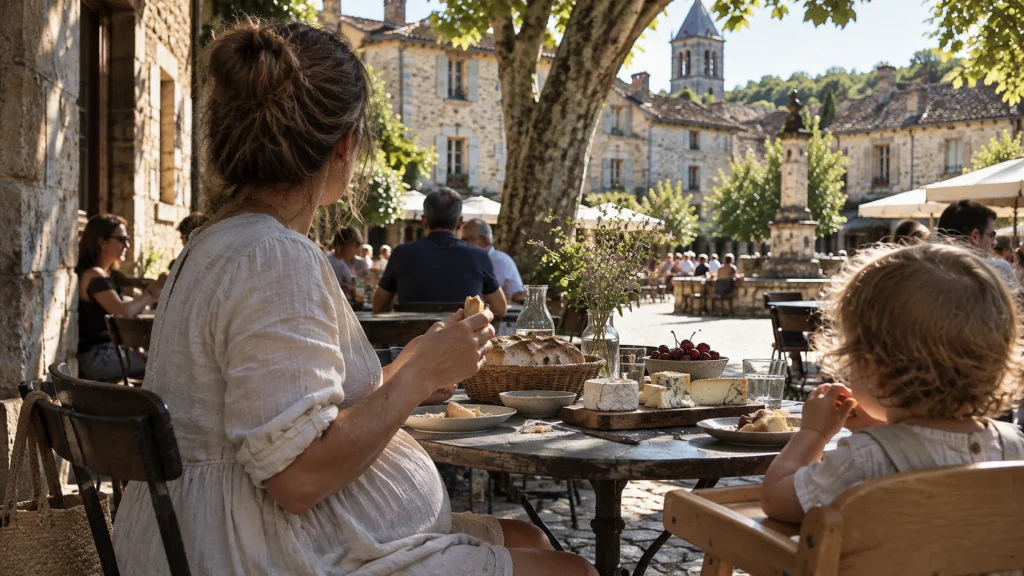
Can toddlers and pregnant women eat raw-milk cheese in France?
Not safely, as a general rule. The French food safety agency ANSES advises that young children, pregnant women, people over 65 and anyone with a weakened immune system avoid raw milk cheese, except hard pressed cheeses such as Gruyère and Comté and any raw-milk cheese cooked through.
Rocamadour, Roquefort and Laguiole are raw by appellation rules, and Ossau-Iraty, Tomme des Pyrénées and market cabécou can be raw too, so read the label for lait cru or lait pasteurisé before you buy.
Pasteurised milk removes the raw-milk concern, but it doesn’t make every soft cheese suitable. UK readers should know the NHS line: pregnant women and young children alike should not eat mould-ripened soft cheeses such as Brie and Camembert, ripened goat’s cheese or soft blue cheeses such as Roquefort unless they are cooked thoroughly. That includes an aged cabécou with a white rind, while Trappe d’Échourgnac is pasteurised and isn’t named. Cooking is the usual way round it: a warm goat’s cheese salad, baked until bubbling all the way through.
In a self-catering gîte you decide what reaches the plate, and our children’s facilities cover the rest of the toddler kit.
This is food safety guidance, not medical advice, so check with your midwife, GP or paediatrician if you are unsure.
Can you bring French cheese back to the UK?
No. Since 12 April 2025, travellers cannot bring cheese or any other dairy product from an EU country into Great Britain for personal use. It makes no difference whether the cheese is raw or pasteurised, vacuum-packed or bought at duty free. Declared cheese is taken away and destroyed, and undeclared cheese can bring a fine of up to £5,000 in England or prosecution. The rule exists to protect British livestock from foot and mouth disease. Rules change, so check GOV.UK before you travel.
Commercial imports aren’t affected, so exported French cheeses still reach UK shops, and a good cheesemonger can find your favourite French ones. Honey’s still allowed in your luggage, so a jar from a market stall is the safe souvenir.
If you only have one cheese morning, spend it at the abbey in Échourgnac, ask for the walnut one and eat it before you leave.
Manoir de Longeveau — 35 self-catering gîtes with heated pools, on-site golf and tennis, minutes from Aubeterre-sur-Dronne.
Browse the gîtes