Getting married in France as a foreigner is one of those ideas that starts as a daydream and, for thousands of couples every year, ends up becoming the plan. It’s not hard to see why. The light in the afternoon, the stone villages that seem to grow out of the hillside, the sense that life here moves at a pace worth actually savouring. But before you start browsing venues, it’s worth understanding how the legal side of things actually works, because it’s more involved than most people realise, and the route you take will shape how you plan everything else.
This guide covers the legal requirements, the paperwork involved, why most foreign couples choose a symbolic ceremony instead, and what makes the Charente-Dordogne border one of the best parts of France to celebrate in.
Can You Legally Get Married in France as a Foreigner?
Yes, you can legally marry in France as a foreign couple, but only through the civil ceremony, the mariage civil, which is the only form of marriage the French state recognises. This must be celebrated by the mayor or a delegated official at the mairie or another authorised communal building; any religious, outdoor or private‑venue ceremony has no legal effect unless the civil marriage has already taken place.
French law requires at least one of you to have a genuine, documented link with the commune where the marriage will be celebrated, known as a ‘lien durable’. That link can be either your domicile, your residence, or the domicile or residence of one of your parents (father or mother), and you must be able to prove it with official documents such as utility bills, a lease or tax notices.
If you rely on residence, it must be established by at least one month of continuous habitation in that commune at the date when the banns (the public notice of marriage) are published. Simply visiting on a tourist stay or choosing a pretty village with no real residential or parental link is not enough, and being born in a commune without living there does not in itself give you the right to marry there.
If you are both foreign and do not live in France, marriage at a mainland French mairie is only possible if you meet these domicile/residence/parent criteria; otherwise, the law provides that your civil marriage is normally celebrated at your own consulate or in certain French overseas territories such as overseas collectivities or New Caledonia. This is why, in practice, many foreign couples without an existing tie to France find the mairie route demanding and often look for alternatives.
What Documents Do You Need to Marry in France?

The paperwork for a legal civil marriage in France is substantial, and each document has to meet specific age, format and translation rules before the mairie will accept your dossier. Both partners must supply valid photo identification (such as a passport), the original and photocopy, plus proof of domicile or residence in the chosen commune or in the commune of a qualifying parent, typically via recent utility bills, a lease, tax notices or similar official documents.
You will also need recent birth certificates with details of your parents; if the act was established in France or in the French civil register for French nationals born abroad, it must generally be less than three months old on the date the dossier is lodged, while a foreign‑issued birth certificate must usually be less than six months old. If either of you has been married before, you must provide the final divorce judgment or the death certificate of your former spouse, and these documents must also be translated if they are not in French.
As foreign nationals, you can expect the mairie to ask for a certificat de coutume (setting out the marriage rules of your home country and evidence of your civil status) and a certificate of celibacy or capacity to marry, generally issued by your embassy or consulate. Depending on your country of origin, your documents may also need to be legalised or bear an apostille, and in some cases your embassy will need to certify that your country does not update civil‑status acts regularly, in which case an older act can still be accepted.
Any document not in French must be translated by a sworn translator (traducteur assermenté); translations by friends, colleagues or generic online tools are not accepted. Once the dossier is complete and accepted, the mairie publishes the banns: public notices of your intended marriage, displayed for ten days at the door of the mairie where the marriage will take place and at the mairie of your domicile, and the marriage cannot be celebrated before the tenth day after publication.
On the day itself, your civil ceremony must be held in a public room of the mairie or another communal building, and you must have between two and four witnesses who are of age and provide their identity details and ID copies in advance. The ceremony is conducted in French by the mayor or a deputy, though an interpreter can attend at your expense if you do not understand French well, and at the end you will be given a Livret de famille, the family record book used to register future events such as the birth of children.
The Route Most Foreign Couples Actually Take
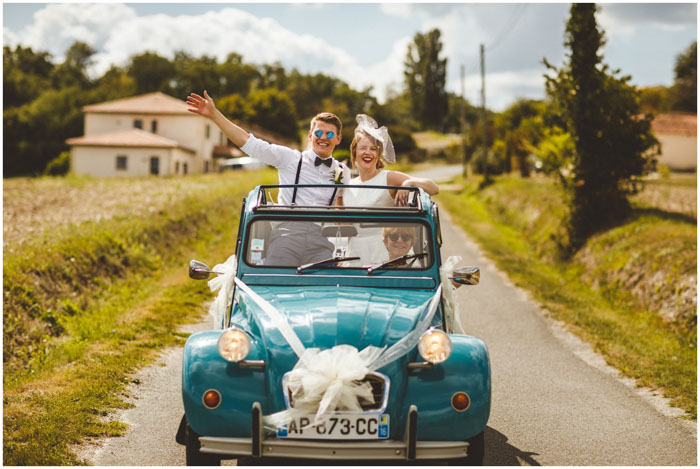
The reality is that the majority of couples getting married in France as foreigners do not go through the civil ceremony process at all. Instead, they marry legally in their home country first, then travel to France to celebrate with a symbolic ceremony. This has become standard practice rather than a workaround, and it’s worth understanding why.
A symbolic ceremony has no legal requirements attached to it. There is no residency to establish, no translated dossier to submit, and no administrative process to navigate in a foreign language. You book your venue, work with an officiant to write a ceremony that actually sounds like you, and the whole day is designed around what you want rather than what the mairie requires.
Guests almost never know which route a couple has taken. A symbolic ceremony looks and feels identical to a legal one. The vows are real, the emotion is real, and the celebration that follows carries exactly the same weight and meaning. The only practical difference is that the paperwork was handled quietly at home before the trip, without the additional pressure of foreign administration in the weeks before the biggest day of your lives.
Why the Charente-Dordogne Border Is Worth Considering
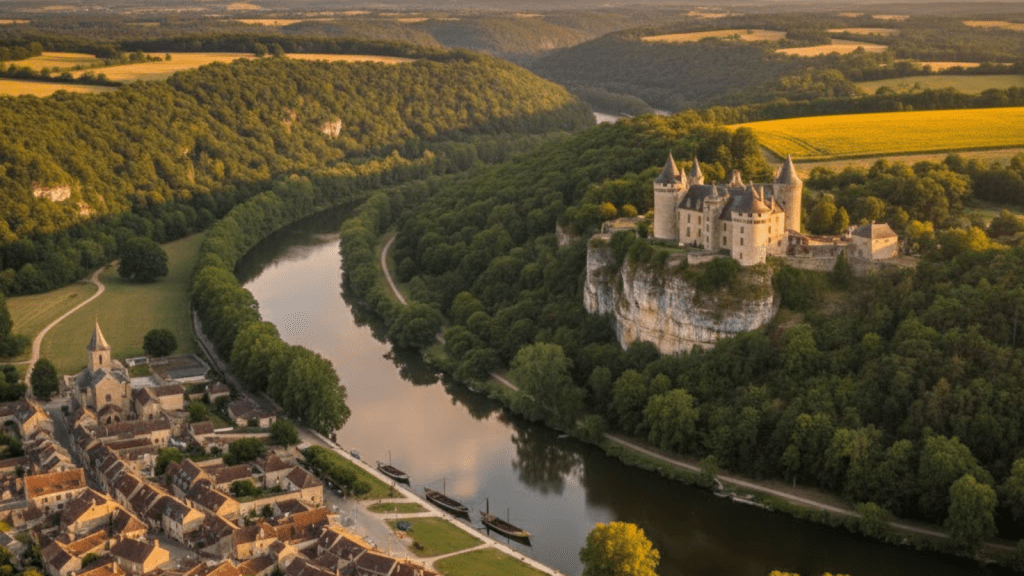
If you’ve decided France is where you want to celebrate, the southwest offers something the better-known regions simply can’t match: genuine rural life that has barely shifted in centuries, without the crowds or the prices that come with more heavily marketed destinations.
The Charente and Dordogne border sits at the quieter, greener end of France. The landscape is rolling and lush, the summers are long and warm, and the pace of life feels like the thing you’ve been looking for. The estate at Longeveau sits right on this border, five minutes from Aubeterre-sur-Dronne, one of France’s most beautiful villages, a village built into a white chalk cliff above the Dronne river that stops people mid-sentence the first time they see it.
Mariages à Longeveau work particularly well for groups who want the whole celebration to feel like a proper stay rather than a single event. The estate has 32 stone cottages sleeping between two and ten guests, meaning the entire wedding party can stay together on site rather than spreading across multiple hotels. Our wedding accommodation keeps everyone in the same place from the day before right through to the morning after, which changes the feel of the whole weekend considerably.
There is a bar and restaurant on the property, a 9-hole golf course, tennis courts and pools, so the days surrounding the ceremony feel full and relaxed rather than empty. The atmosphere at weddings here tends to be one where the speeches run long because people genuinely have things to say, and the dancing goes well past midnight because nobody is watching the clock.
For guests who want to explore further, Angoulême and Périgueux are both about forty-five minutes away and offer excellent restaurants, weekly markets and enough to fill a couple of days easily. Brantôme, sometimes called the Venice of Périgord, is around fifty minutes away and makes for a beautiful afternoon out for anyone who arrives early.
Planning Timeline: How Far Ahead Do You Need to Think?

For a symbolic ceremony in France, your key deadlines are actually the ones at home. You need to be legally married before your French celebration takes place, your home paperwork needs to be sorted, and you need to secure your venue well ahead of peak summer dates. For July and August at sought-after venues, booking twelve to eighteen months out is sensible.
For a legal civil ceremony in France, the timeline is considerably longer. You will want to research the specific requirements of the mairie in the commune where you plan to marry, since requirements can vary slightly between municipalities. Allow at least six months, and preferably more, to gather and translate documentation and establish the necessary residency.
Either way, the most useful thing you can do early in the process is speak to your venue. Venues that regularly host international weddings will have dealt with most of the questions before and can recommend local English-speaking officiants, sworn translators and wedding planners who know the local process. If you would like to talk through what a wedding at Longeveau could look like for your group, get in touch and the team will take it from there.
Getting married in France as a foreigner is entirely possible, and for couples who have spent any time in the southwest, it tends to feel less like a decision and more like an inevitability. The Charente-Dordogne border has a quality that’s difficult to put into words but easy to feel when you’re there. The sense that this landscape has been quietly extraordinary for a very long time, and that a day celebrated here will stay with you in ways a more conventional venue wouldn’t.
If you’d like to find out more about what a wedding at Longeveau looks like in practice, get in touch, and the team will be happy to talk through the options.